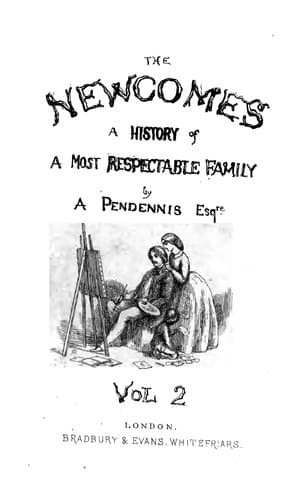
The Newcomes: Memoirs of a Most Respectable FamilyThackeray, William Makepeace
General
The Newcomes: Memoirs of a Most Respectable Family
Thackeray, William Makepeace
Domestic fiction; Families -- England -- Fiction
Her only unmarried daughter, Lady Julia, lived with her ladyship. Poor
Lady Julia had suffered early from a spine disease, which had kept her
for many years to her couch. Being always at home, and under her
mother’s eyes, she was the old lady’s victim, her pincushion, into
which Lady Kew plunged a hundred little points of sarcasm daily. As
children are sometimes brought before magistrates, and their poor
little backs and shoulders laid bare, covered with bruises and lashes
which brutal parents have inflicted, so, I dare say, if there had been
any tribunal or judge, before whom this poor patient lady’s heart could
have been exposed, it would have been found scarred all over with
numberless ancient wounds, and bleeding from yesterday’s castigation.
Old Lady Kew’s tongue was a dreadful thong which made numbers of people
wince. She was not altogether cruel, but she knew the dexterity with
which she wielded her lash, and liked to exercise it. Poor Lady Julia
was always at hand, when her mother was minded to try her powers.
Lady Kew had just made herself comfortable at Brighton, when her little
grandson’s illness brought Lady Anne Newcome and her family down to the
sea. Lady Kew was almost scared back to London again, or blown over the
water to Dieppe. She had never had the measles. “Why did not Anne carry
the child to some other place? Julia, you will on no account go and see
that little pestiferous swarm of Newcomes, unless you want to send me
out of the world—which I dare say you do, for I am a dreadful plague to
you, I know, and my death would be a release to you.”
“You see Doctor H., who visits the child every day,” cries poor
Pincushion; “you are not afraid when he comes.”
“Doctor H.? Doctor H. comes to cure me, or to tell me the news, or to
flatter me, or to feel my pulse and to pretend to prescribe, or to take
his guinea; of course Dr. H. must go to see all sorts of people in all
sorts of diseases. You would not have me be such a brute as to order
him not to attend my own grandson? I forbid you to go to Anne’s house.
You will send one of the men every day to inquire. Let the groom
go—yes, Charles—he will not go into the house. He will ring the bell
and wait outside. He had better ring the bell at the area—I suppose
there is an area—and speak to the servants through the bars, and bring
us word how Alfred is.” Poor Pincushion felt fresh compunctions; she
had met the children, and kissed the baby, and held kind Ethel’s hand
in hers, that day, as she was out in her chair. There was no use,
however, to make this confession. Is she the only good woman or man of
whom domestic tyranny has made a hypocrite?
Public-domain text, read in full here on John Shaqi.
Reviews
Reviews
No reviews yet
Be the first to share your thoughts on this work.
Elsewhere in the archive
Join the Discussion
Join the discussion
Sign in to leave a comment or review.
Sign InorCreate an account