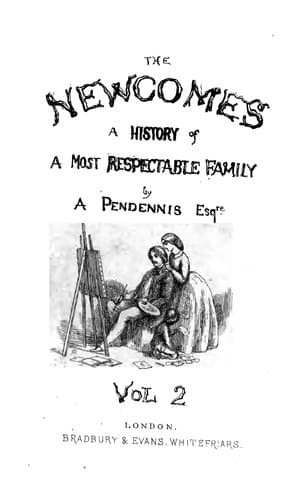
The Newcomes: Memoirs of a Most Respectable FamilyThackeray, William Makepeace
General
The Newcomes: Memoirs of a Most Respectable Family
Thackeray, William Makepeace
Domestic fiction; Families -- England -- Fiction
“‘Two girls,’ continues that indomitable Mr. Gandish. ‘Hidea for “Babes
in the Wood.” “View of Pæstum,” taken on the spot by myself, when
travelling with the late lamented Earl of Kew. ‘Beauty, Valour,
Commerce, and Liberty, condoling with Britannia on the death of Admiral
Viscount Nelson,’—allegorical piece drawn at a very early age after
Trafalgar. Mr. Fuseli saw that piece, sir, when I was a student of the
Academy, and said to me, ‘Young man, stick to the antique. There’s
nothing like it.’ Those were ’is very words. If you do me the favour to
walk into the Hatrium, you’ll remark my great pictures also from
English ’istry. An English historical painter, sir, should be employed
chiefly in English ’istry. That’s what I would have done. Why ain’t
there temples for us, where the people might read their history at a
glance, and without knowing how to read? Why is my ‘Alfred’ ’anging up
in this ’all? Because there is no patronage for a man who devotes
himself to Igh art. You know the anecdote, Colonel? King Alfred flying
from the Danes, took refuge in a neaterd’s ’ut. The rustic’s wife told
him to bake a cake, and the fugitive sovering set down to his ignoble
task, and forgetting it in the cares of state, let the cake burn, on
which the woman struck him. The moment chose is when she is lifting her
’and to deliver the blow. The king receives it with majesty mingled
with meekness. In the background the door of the ’ut is open, letting
in the royal officers to announce the Danes are defeated. The daylight
breaks in at the aperture, signifying the dawning of ’Ope. That story,
sir, which I found in my researches in ’istry, has since become so
popular, sir, that hundreds of artists have painted it, hundreds! I who
discovered the legend, have my picture—here!’
“‘Now, Colonel,’ says the showman, ‘let me—let me lead you through the
statue gallery. ‘Apollo,’ you see. The ‘Venus Hanadyomene,’ the
glorious Venus of the Louvre, which I saw in 1814, Colonel, in its
glory—the ‘Laocoon’—my friend Gibson’s ‘Nymth,’ you see, is the only
figure I admit among the antiques. Now up this stair to the students’
room, where I trust my young friend, Mr. Newcome, will labour
assiduously. _Ars longa est_, Mr. Newcome. _Vita_——’”
“I trembled,” Clive said, “lest my father should introduce a certain
favourite quotation, beginning ‘_ingenuas didicisse_’—but he refrained,
and we went into the room, where a score of students were assembled,
who all looked away from their drawing-boards as we entered.
Public-domain text, read in full here on John Shaqi.
Reviews
Reviews
No reviews yet
Be the first to share your thoughts on this work.
Elsewhere in the archive
Join the Discussion
Join the discussion
Sign in to leave a comment or review.
Sign InorCreate an account