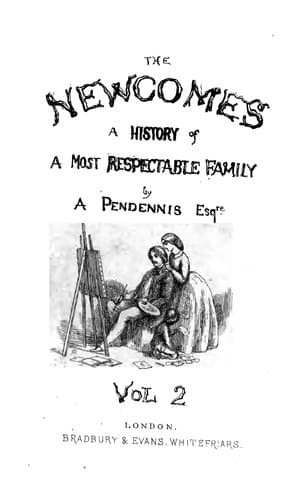
The Newcomes: Memoirs of a Most Respectable FamilyThackeray, William Makepeace
General
The Newcomes: Memoirs of a Most Respectable Family
Thackeray, William Makepeace
Domestic fiction; Families -- England -- Fiction
“That nabob of ours is a queer fish,” Hobson Newcome remarked to his
nephew Barnes. “He is as proud as Lucifer, he is always taking huff
about one thing or the other. He went off in a fume the other night
because your aunt objected to his taking the boys to the play. She
don’t like their going to the play. My mother didn’t either. Your aunt
is a woman who is uncommon wideawake, I can tell you.”
“I always knew, sir, that my aunt was perfectly aware of the time of
the day,” says Barnes, with a bow.
“And then the Colonel flies out about his boy, and says that my wife
insulted him! I used to like that boy. Before his father came he was a
good lad enough—a jolly brave little fellow.”
“I confess I did not know Mr. Clive at that interesting period of his
existence,” remarks Barnes.
“But since he has taken this madcap freak of turning painter,” the
uncle continues, “there is no understanding the chap. Did you ever see
such a set of fellows as the Colonel had got together at his party the
other night? Dirty chaps in velvet coats and beards? They looked like a
set of mountebanks. And this young Clive is going to turn painter!”
“Very advantageous thing for the family. He’ll do our pictures for
nothing. I always said he was a darling boy,” simpered Barnes.
“Darling jackass!” growled out the senior. “Confound it, why doesn’t my
brother set him up in some respectable business? I ain’t proud. I have
not married an earl’s daughter. No offence to you, Barnes.”
“Not at all, sir. I can’t help it if my grandfather is a gentleman,”
says Barnes, with a fascinating smile.
The uncle laughs. “I mean I don’t care what a fellow is if he is a good
fellow. But a painter! hang it—a painter’s no trade at all—I don’t
fancy seeing one of our family sticking up pictures for sale. I don’t
like it, Barnes.”
“Hush! here comes his distinguished friend, Mr. Pendennis,” whispers
Barnes; and the uncle growling out, “Damn all literary fellows—all
artists—the whole lot of them!” turns away. Barnes waves three languid
fingers of recognition towards Pendennis: and when the uncle and nephew
have moved out of the club newspaper room, little Tom Eaves comes up
and tells the present reporter every word of their conversation.
Public-domain text, read in full here on John Shaqi.
Reviews
Reviews
No reviews yet
Be the first to share your thoughts on this work.
Elsewhere in the archive
Join the Discussion
Join the discussion
Sign in to leave a comment or review.
Sign InorCreate an account