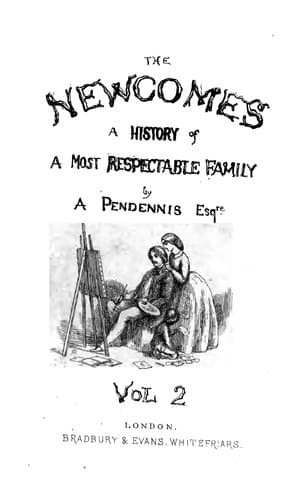
The Newcomes: Memoirs of a Most Respectable FamilyThackeray, William Makepeace
General
The Newcomes: Memoirs of a Most Respectable Family
Thackeray, William Makepeace
Domestic fiction; Families -- England -- Fiction
The Colonel comes to Park Street early in the forenoon, when the
mistress of the house, surrounded by her little ones, is administering
dinner to them. He behaves with splendid courtesy to Miss Quigley, the
governess, and makes a point of taking wine with her, and of making a
most profound bow during that ceremony. Miss Quigley cannot help
thinking Colonel Newcome’s bow very fine. She has an idea that his late
Majesty must have bowed in that way: she flutteringly imparts this
opinion to Lady Anne’s maid; who tells her mistress, who tells Miss
Ethel, who watches the Colonel the next time he takes wine with Miss
Quigley, and they laugh, and then Ethel tells him; so that the
gentleman and the governess have to blush ever after when they drink
wine together. When she is walking with her little charges in the Park,
or in that before-mentioned paradise nigh to Apsley House, faint
signals of welcome appear on her wan cheeks. She knows the dear Colonel
amongst a thousand horsemen. If Ethel makes for her uncle purses,
guard-chains, antimacassars, and the like beautiful and useful
articles, I believe it is in reality Miss Quigley who does four-fifths
of the work, as she sits alone in the schoolroom, high, high up in that
lone house, when the little ones are long since asleep, before her
dismal little tea-tray, and her little desk containing her mother’s
letters and her mementos of home.
There are, of course, numberless fine parties in Park Lane, where the
Colonel knows he would be very welcome. But if there be grand
assemblies, he does not care to come. “I like to go to the club best,”
he says to Lady Anne. “We talk there as you do here about persons, and
about Jack marrying, and Tom dying, and so forth. But we have known
Jack and Tom all our lives, and so are interested in talking about
them. Just as you are in speaking of your own friends and habitual
society. They are people whose names I have sometimes read in the
newspaper, but whom I never thought of meeting until I came to your
house. What has an old fellow like me to say to your young dandies or
old dowagers?”
“Mamma is very odd and sometimes very captious, my dear Colonel,” said
Lady Anne, with a blush; “she suffers so frightfully from tic that we
are all bound to pardon her.”
Public-domain text, read in full here on John Shaqi.
Reviews
Reviews
No reviews yet
Be the first to share your thoughts on this work.
Elsewhere in the archive
Join the Discussion
Join the discussion
Sign in to leave a comment or review.
Sign InorCreate an account