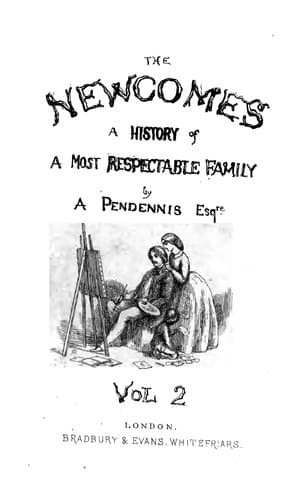
The Newcomes: Memoirs of a Most Respectable FamilyThackeray, William Makepeace
General
The Newcomes: Memoirs of a Most Respectable Family
Thackeray, William Makepeace
Domestic fiction; Families -- England -- Fiction
Sometimes he would have a company of such gentlemen as Messrs.
Warrington, Honeyman, and Pendennis, when haply a literary conversation
would ensue after dinner; and the merits of our present poets and
writers would be discussed with the claret. Honeyman was well enough
read in profane literature, especially of the lighter sort; and, I dare
say, could have passed a satisfactory examination in Balzac, Dumas, and
Paul de Kock himself, of all whose works our good host was entirely
ignorant,—as indeed he was of graver books, and of earlier books, and
of books in general—except those few which we have said formed his
travelling library. He heard opinions that amazed and bewildered him.
He heard that Byron was no great poet, though a very clever man. He
heard that there had been a wicked persecution against Mr. Pope’s
memory and fame, and that it was time to reinstate him; that his
favourite, Dr. Johnson, talked admirably, but did not write English:
that young Keats was a genius to be estimated in future days with young
Raphael: and that a young gentleman of Cambridge who had lately
published two volumes of verses, might take rank with the greatest
poets of all. Doctor Johnson not write English! Lord Byron not one of
the greatest poets of the world! Sir Walter a poet of the second order!
Mr. Pope attacked for inferiority and want of imagination; Mr. Keats
and this young Mr. Tennyson of Cambridge, the chief of modern poetic
literature! What were these new dicta, which Mr. Warrington delivered
with a puff of tobacco-smoke: to which Mr. Honeyman blandly assented
and Clive listened with pleasure? Such opinions were not of the
Colonel’s time. He tried in vain to construe Oenone, and to make sense
of Lamia. Ulysses he could understand; but what were these prodigious
laudations bestowed on it? And that reverence for Mr. Wordsworth, what
did it mean? Had he not written Peter Bell, and been turned into
deserved ridicule by all the reviews? Was that dreary Excursion to be
compared to Goldsmith’s Traveller, or Doctor Johnson’s Imitation of the
Tenth Satire of Juvenal? If the young men told the truth, where had
been the truth in his own young days, and in what ignorance had our
forefathers been brought up?—Mr. Addison was only an elegant essayist,
and shallow trifler! All these opinions were openly uttered over the
Colonel’s claret, as he and Mr. Binnie sate wondering at the speakers,
who were knocking the gods of their youth about their ears. To Binnie
the shock was not so great; the hard-headed Scotchman had read Hume in
his college days, and sneered at some of the gods even at that early
time. But with Newcome the admiration for the literature of the last
century was an article of belief: and the incredulity of the young men
seemed rank blasphemy. “You will be sneering at Shakspeare next,” he
said: and was silenced, though not better pleased, when his youthful
guests told him, that Doctor Goldsmith sneered at him too; that Dr.
Public-domain text, read in full here on John Shaqi.
Reviews
Reviews
No reviews yet
Be the first to share your thoughts on this work.
Elsewhere in the archive
Join the Discussion
Join the discussion
Sign in to leave a comment or review.
Sign InorCreate an account