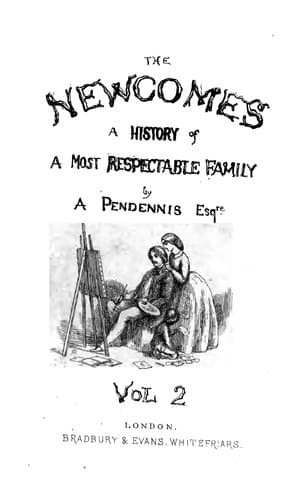
The Newcomes: Memoirs of a Most Respectable FamilyThackeray, William Makepeace
General
The Newcomes: Memoirs of a Most Respectable Family
Thackeray, William Makepeace
Domestic fiction; Families -- England -- Fiction
“‘1367. “Oberon and Titania.” Ridley.—This sweet and fanciful little
picture draws crowds round about it, and is one of the most charming
and delightful works of the present exhibition. We echo the universal
opinion in declaring that it shows not only the greatest promise, but
the most delicate and beautiful performance. The Earl of Kew, we
understand, bought the picture at the private view; and we congratulate
the young painter heartily upon his successful _début_. He is, we
understand, a pupil of Mr. Gandish. Where is that admirable painter? We
miss his bold canvasses and grand historic outline.’
“I shall alter a few inaccuracies in the composition of our friend F.
B., who has, as he says, ‘drawn it uncommonly mild in the above
criticism.’ In fact, two days since, he brought in an article of quite
a different tendency, of which he retains only the two last paragraphs;
but he has, with great magnanimity, recalled his previous observations;
and, indeed, he knows as much about pictures as some critics I could
name.
“Good-bye, my dear Clive! I send my kindest regards to your father; and
think you had best see as little as possible of your bouillotte-playing
French friend and his friends. This advice I know you will follow, as
young men always follow the advice of their seniors and well-wishers. I
dine in Fitzroy Square to-day with the pretty widow and her daughter,
and am yours always, dear Clive, A. P.”
CHAPTER XXIII.
In which we hear a Soprano and a Contralto
The most hospitable and polite of Colonels would not hear of Mrs.
Mackenzie and her daughter quitting his house when he returned to it,
after six weeks’ pleasant sojourn in Paris; nor, indeed, did his fair
guest show the least anxiety or intention to go away. Mrs. Mackenzie
had a fine merry humour of her own. She was an old soldier’s wife, she
said and knew when her quarters were good; and I suppose, since her
honeymoon, when the captain took her to Harrogate and Cheltenham,
stopping at the first hotels, and travelling in a chaise-and-pair the
whole way, she had never been so well off as in that roomy mansion near
Tottenham Court Road. Of her mother’s house at Musselburgh she gave a
ludicrous but dismal account. “Eh, James,” she said, “I think if you
had come to mamma, as you threatened, you would not have staid very
long. It’s a wearisome place. Dr. M’Craw boards with her; and it’s
sermon and psalm-singing from morning till night. My little Josey takes
kindly to the life there, and I left her behind, poor little darling!
It was not fair to bring three of us to take possession of your house,
dear James; but my poor little Rosey was just withering away there.
It’s good for the dear child to see the world a little, and a kind
uncle, who is not afraid of us now he sees us, is he?” Kind Uncle James
was not at all afraid of little Rosey; whose pretty face and modest
manners, and sweet songs, and blue eyes, cheered and soothed the old
bachelor.
Public-domain text, read in full here on John Shaqi.
Reviews
Reviews
No reviews yet
Be the first to share your thoughts on this work.
Elsewhere in the archive
Join the Discussion
Join the discussion
Sign in to leave a comment or review.
Sign InorCreate an account