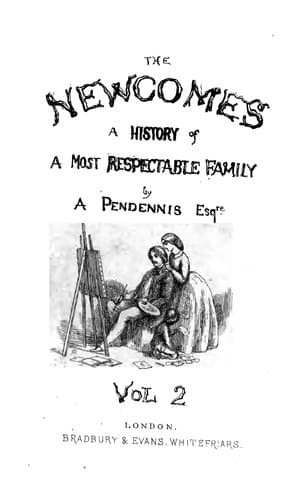
The Newcomes: Memoirs of a Most Respectable FamilyThackeray, William Makepeace
General
The Newcomes: Memoirs of a Most Respectable Family
Thackeray, William Makepeace
Domestic fiction; Families -- England -- Fiction
rise and ascend to the drawing-room. Miss Newcome has been watching the
behaviour of the author by whom she sate; curious to know what such a
person’s habits are; whether he speaks and acts like other people; and
in what respect authors are different from persons “in society.”
When we had sufficiently enjoyed claret and politics below-stairs, the
gentlemen went to the drawing-room to partake of coffee and the ladies’
delightful conversation. We had heard previously the tinkling of the
piano above, and the well-known sound of a couple of Miss Rosey’s five
songs. The two young ladies were engaged over an album at a side-table,
when the males of the party arrived. The book contained a number of
Clive’s drawings made in the time of his very early youth for the
amusement of his little cousins. Miss Ethel seemed to be very much
pleased with these performances, which Miss Mackenzie likewise examined
with great good-nature and satisfaction. So she did the views of Rome,
Naples, Marble Hill in the county of Sussex, etc., in the same
collection: so she did the Berlin cockatoo and spaniel which Mrs.
Newcome was working in idle moments: so she did the “Books of Beauty,”
“Flowers of Loveliness,” and so forth. She thought the prints very
sweet and pretty: she thought the poetry very pretty and sweet. Which
did she like best, Mr. Niminy’s “Lines to a bunch of violets,” or Miss
Piminy’s “Stanzas to a wreath of roses”? Miss Mackenzie was quite
puzzled to say which of these masterpieces she preferred; she found
them alike so pretty. She appealed, as in most cases, to mamma. “How,
my darling love, can I pretend to know?” mamma says. “I have been a
soldier’s wife, battling about the world. I have not had your
advantages. I had no drawing-masters, nor music-masters as you have.
You, dearest child, must instruct me in these things.” This poses
Rosey: who prefers to have her opinions dealt out to her like her
frocks, bonnets, handkerchiefs, her shoes and gloves, and the order
thereof; the lumps of sugar for her tea, the proper quantity of
raspberry jam for breakfast; who trusts for all supplies corporeal and
spiritual to her mother. For her own part, Rosey is pleased with
everything in nature. Does she love music? Oh, yes. Bellini and
Donizetti? Oh, yes. Dancing? They had no dancing at grandmamma’s, but
she adores dancing, and Mr. Clive dances very well indeed. (A smile
from Miss Ethel at this admission.) Does she like the country? Oh, she
is so happy in the country! London? London is delightful, and so is the
seaside. She does not really know which she likes best, London or the
country, for mamma is not near her to decide, being engaged listening
to Sir Brian, who is laying down the law to her, and smiling, smiling
with all her might. In fact, Mr. Newcome says to Mr. Pendennis in his
droll, humorous way, “That woman grins like a Cheshire cat.” Who was
the naturalist who first discovered that peculiarity of the cats in
Cheshire?
Public-domain text, read in full here on John Shaqi.
Reviews
Reviews
No reviews yet
Be the first to share your thoughts on this work.
Elsewhere in the archive
Join the Discussion
Join the discussion
Sign in to leave a comment or review.
Sign InorCreate an account