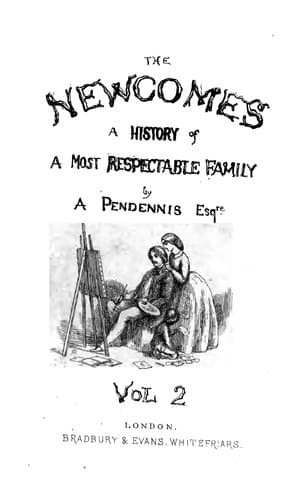
The Newcomes: Memoirs of a Most Respectable FamilyThackeray, William Makepeace
General
The Newcomes: Memoirs of a Most Respectable Family
Thackeray, William Makepeace
Domestic fiction; Families -- England -- Fiction
“Well, then, sir, poor Charles thought to make it all right by marrying
Mrs. Brumby;—and she was very fond of him and the thing was all but
done, in spite of her sons, who were in a rage as you may fancy. But
Charley, sir, has such a propensity for humbug that he will tell lies
when there is no earthly good in lying. He represented his chapel at
twelve hundred a year, his private means as so-and-so; and when he came
to book up with Briggs the lawyer, Mrs. Brumby’s brother, it was found
that he lied and prevaricated so, that the widow in actual disgust
would have nothing more to do with him. She was a good woman of
business, and managed the hat-shop for nine years, whilst poor Brumby
was at Dr. Tokelys. A first-rate shop it was, too. I introduced Charles
to it. My uncle the Bishop had his shovels there: and they used for a
considerable period to cover _this_ humble roof with tiles,” said F.
B., tapping his capacious forehead; “I am sure he might have had
Brumby,” he added, in his melancholy tones, “but for those unlucky
lies. She didn’t want money. She had plenty. She longed to get into
society, and was bent on marrying a gentleman.
“But what I can’t pardon in Honeyman is the way in which he has done
poor old Ridley and his wife. I took him there, you know, thinking they
would send their bills in once a month: that he was doing a good
business: in fact, that I had put ’em into a good thing. And the fellow
has told me a score of times that he and the Ridleys were all right.
But he has not only not paid his lodgings, but he has had money of
them: he has given dinners: he has made Ridley pay for wine. He has
kept paying lodgers out of the house, and he tells me all this with a
burst of tears, when he sent for me to Lazarus’s to-night, and I went
to him, sir, because he was in distress—went into the lion’s den, sir!”
says F. B., looking round nobly. “I don’t know how much he owes them:
because of course you know the sum he mentions ain’t the right one. He
never does tell the truth—does Charles. But think of the pluck of those
good Ridleys never saying a single word to F. B. about the debt! ‘We
are poor, but we have saved some money and can lie out of it. And we
think Mr. Honeyman will pay us,’ says Mrs. Ridley to me this very
evening. And she thrilled my heart-strings, sir; and I took her in my
arms, and kissed the old woman,” says Bayham; “and I rather astonished
little Miss Cann, and young J. J., who came in with a picture under his
arm. But she said she had kissed Master Frederick long before J. J. was
born—and so she had: that good and faithful servant—and my emotion in
embracing her was manly, sir, manly.”
Here old Betsy came in to say that the supper was a-waitin’ for Mr.
Bayham and it was a-getting’ very late; and we left F. B. to his meal;
and bidding adieu to Mrs. Nokes, Clive and I went each to our
habitation.
CHAPTER XXVI.
In which Colonel Newcome’s Horses are sold
Public-domain text, read in full here on John Shaqi.
Reviews
Reviews
No reviews yet
Be the first to share your thoughts on this work.
Elsewhere in the archive
Join the Discussion
Join the discussion
Sign in to leave a comment or review.
Sign InorCreate an account