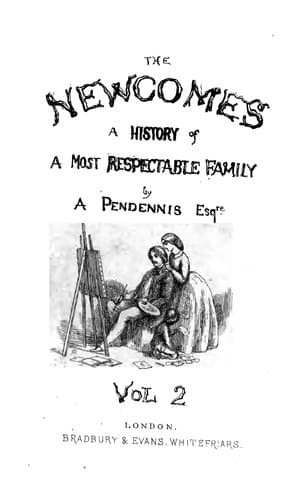
The Newcomes: Memoirs of a Most Respectable FamilyThackeray, William Makepeace
General
The Newcomes: Memoirs of a Most Respectable Family
Thackeray, William Makepeace
Domestic fiction; Families -- England -- Fiction
Although Thomas Newcome was gone back to India in search of more money,
finding that he could not live upon his income at home, he was
nevertheless rather a wealthy man; and at the moment of his departure
from Europe had two lakhs of rupees invested in various Indian
securities. “A thousand a year,” he thought, “more, added to the
interest accruing from my two lakhs, will enable us to live very
comfortably at home. I can give Clive ten thousand pounds when he
marries, and five hundred a year out of my allowances. If he gets a
wife with some money, they may have every enjoyment of life; and as for
his pictures, he can paint just as few or as many of those as he
pleases.” Newcome did not seem seriously to believe that his son would
live by painting pictures, but considered Clive as a young prince who
chose to amuse himself with painting. The Muse of Painting is a lady
whose social station is not altogether recognised with us as yet. The
polite world permits a gentleman to amuse himself with her; but to take
her for better or for worse! forsake all other chances and cleave unto
her! to assume her name! Many a respectable person would be as much
shocked at the notion, as if his son had married an opera-dancer.
Newcome left a hundred a year in England, of which the principal sum
was to be transferred to his boy as soon as he came of age. He endowed
Clive further with a considerable annual sum, which his London bankers
would pay: “And if these are not enough,” says he kindly, “you must
draw upon my agents, Messrs. Frank and Merryweather at Calcutta, who
will receive your signature just as if it was mine.” Before going away,
he introduced Clive to F. and M.’s corresponding London house, Jolly
and Baines, Fog Court—leading out of Leadenhall—Mr. Jolly, a myth as
regarded the firm, now married to Lady Julia Jolly—a Park in
Kent—evangelical interest—great at Exeter Hall meetings—knew Clive’s
grandmother—that is, Mrs. Newcome, a most admirable woman. Baines
represents a house in the Regent’s Park, with an emigrative tendency
towards Belgravia—musical daughters—Herr Moscheles, Benedick,
Ella,—Osborne, constantly at dinner-sonatas in P flat (op. 936),
composed and dedicated to Miss Euphemia Baines, by her most obliged,
most obedient servant, Ferdinando Blitz. Baines hopes that his young
friend will come constantly to York Terrace, where the most girls will
be happy to see him; and mentions at home a singular whim of Colonel
Newcome’s, who can give his son twelve or fifteen hundred a year, and
makes an artist of him. Euphemia and Flora adore artists; they feel
quite interested about this young man. “He was scribbling caricatures
all the time I was talking with his father in my parlour,” says Mr.
Baines, and produces a sketch of an orange-woman near the Bank, who had
struck Clive’s eyes, and been transferred to the blotting-paper in Fog
Court. “_He_ needn’t do anything,” said good-natured Mr. Baines. “I
Public-domain text, read in full here on John Shaqi.
Reviews
Reviews
No reviews yet
Be the first to share your thoughts on this work.
Elsewhere in the archive
Join the Discussion
Join the discussion
Sign in to leave a comment or review.
Sign InorCreate an account