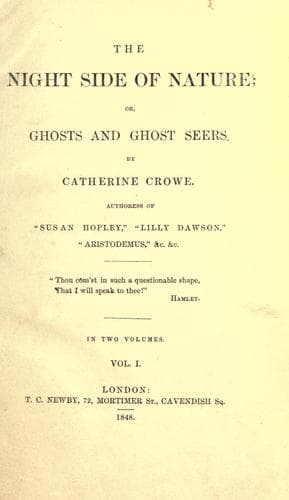
The Night-Side of Nature; Or, Ghosts and Ghost-SeersCrowe, Catherine
Religion
The Night-Side of Nature; Or, Ghosts and Ghost-Seers
Crowe, Catherine
Ghosts; Parapsychology
About three years ago, I had several opportunities of seeing two young
girls, then under the care of a Mr. A——, of Edinburgh, who hoped,
chiefly by means of magnetism, to restore them to sight. One was a
maid-servant afflicted with amaurosis, whom he had taken into his house
from a charitable desire to be of use to her; the other, who had been
blind from her childhood, was a young lady in better circumstances, the
daughter of respectable tradespeople in the north of England. The girl
with amaurosis was restored to sight, and the other was so far benefited
that she could distinguish houses, trees, carriages, &c., and at length,
though obscurely, the features of a person near her. At this period of
the curé she was, unhappily, removed, and may possibly have relapsed
into her former state. My reason, however, for alluding to these young
women on this occasion is, that they were in the habit of saying, when
in the magnetic state—for they were both, more or less,
_clairvoyantes_—that the people whom Dr. A—— was magnetizing, in the
same room, presented very different appearances. Some of them they
described as looking bright, while others were, in different degrees,
streaked with black.
One or two they mentioned over whom there seemed to hang a sort of
cloud, like a ragged veil of darkness. They also said, though this was
before any tidings of Baron von Reichenbach’s discoveries had reached
this country, that they saw light streaming from the fingers of Mr.
A—— when he magnetized them; and that sometimes his whole person
seemed to them radiant. Now, I am positively certain that neither Mr.
A—— nor these girls had ever heard of this story of Thespesius;
neither had I, at that time; and I confess, when I did meet with it I
was a good deal struck by the coincidence. These young people said that
it was the “goodness or badness,” meaning the moral state, of the
persons that was thus indicated. Now, surely, this concurrence between
the man mentioned by Plutarch, and these two girls—one of whom had no
education whatever, and the other very little—is worthy of some regard.
I once asked a young person in a highly clairvoyant state, whether she
ever “saw the spirits of them that had passed away;” for so _she_
designated the dead, never using the word _death_ herself, in any of its
forms. She answered me that she did.
“Then where are they?” I inquired.
“Some are waiting, and some are gone on before.”
“Can you speak to them?” I asked.
“No,” she replied, “there is no meddling nor direction.”
In her waking state she would have been quite incapable of these
answers; and that “some are waiting and some gone on before,” seems to
be much in accordance with the vision of Thespesius.
Public-domain text, read in full here on John Shaqi.
Reviews
Reviews
No reviews yet
Be the first to share your thoughts on this work.
Elsewhere in the archive
Join the Discussion
Join the discussion
Sign in to leave a comment or review.
Sign InorCreate an account