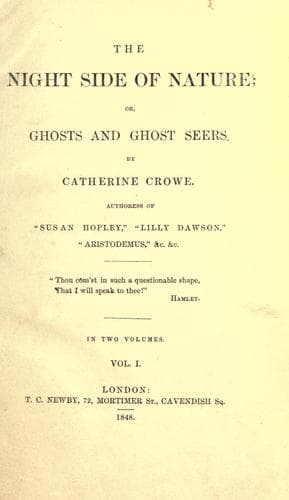
The Night-Side of Nature; Or, Ghosts and Ghost-SeersCrowe, Catherine
Religion
The Night-Side of Nature; Or, Ghosts and Ghost-Seers
Crowe, Catherine
Ghosts; Parapsychology
Mr. P——, the American manager, in one of his voyages to England, being
in bed one night, between sleeping and waking, was disturbed by somebody
coming into his cabin, dripping with water. He concluded that the person
had fallen overboard, and asked him why he came there to disturb him,
when there were plenty of other places for him to go to. The man
muttered something indistinctly, and Mr. P—— then perceived that it
was his own brother. This roused him completely, and feeling quite
certain that somebody had been there, he got out of bed to feel if the
carpet was wet on the spot where his brother stood. It was not, however;
and when he questioned his shipmates, the following morning, they
assured him that nobody had been overboard, nor had anybody been in his
cabin. Upon this, he noted down the date and the particulars of the
event, and, on his arrival at Liverpool, sent the paper sealed to a
friend in London, desiring it might not be opened till he wrote again.
The Indian post, in due time, brought the intelligence that on that
night Mr. P——’s brother was drowned.
A similar case to this is that of Captain Kidd, which Lord Byron used to
say he heard from the captain himself. He was one night awakened in his
hammock, by feeling something heavy lying upon him. He opened his eyes,
and saw, or thought he saw, by the indistinct light in the cabin, his
brother, in uniform, lying across the bed. Concluding that this was only
an illusion arising out of some foregone dream, he closed his eyes again
to sleep; but again he felt the weight, and there was the form still
lying across the bed. He now stretched out his hand, and felt the
uniform, which was quite wet. Alarmed, he called out for somebody to
come to him; and, as one of the officers entered, the figure
disappeared. He afterward learned that his brother was drowned on that
night in the Indian ocean.
Ben Jonson told Drummond, of Hawthornden, that, being at Sir Robert
Cotton’s house, in the country, with old Cambden, he saw, in a vision,
his eldest son, then a child at London, appear to him with a mark of a
bloody cross on his forehead; at which, amazed, he prayed to God; and,
in the morning, mentioned the circumstance to Mr. Cambden, who persuaded
him it was fancy. In the meantime, came letters announcing that the boy
had died of the plague. The custom of indicating an infected house by a
red cross is here suggested, the cross apparently symbolizing the manner
of the death.
Public-domain text, read in full here on John Shaqi.
Reviews
Reviews
No reviews yet
Be the first to share your thoughts on this work.
Elsewhere in the archive
Join the Discussion
Join the discussion
Sign in to leave a comment or review.
Sign InorCreate an account