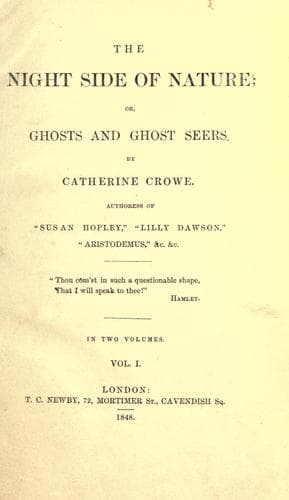
The Night-Side of Nature; Or, Ghosts and Ghost-SeersCrowe, Catherine
Religion
The Night-Side of Nature; Or, Ghosts and Ghost-Seers
Crowe, Catherine
Ghosts; Parapsychology
I mention this because I have met with, and do meet with, people
constantly, who admit this class of facts, while they declare they can
not believe in ghosts; the instances, they say, of people being seen at
a distance at the period of their death, are too numerous to permit of
the fact being denied. In granting it, however, they seem to me to grant
everything. If, as I have said above, the person be dead, the form seen
is a ghost or spectre, whether he has been dead a second or a century;
if he be alive, the difficulty is certainly not diminished; on the
contrary, it appears to me to be considerably augmented; and it is to
this perplexing class of facts that I shall next proceed, namely, those
in which the person is not only alive, as in some of the cases above
related, but where the phenomenon seems to occur without any reference
to the death of the subject, present or prospective.
In either case, we are forced to conclude that the thing seen is the
same; the questions are, what is it that we see, and how does it render
itself visible? and, still more difficult to answer, appears the
question, of how it can communicate intelligence, or exert a mechanical
force. As, however, this investigation will be more in its place when I
have reached that department of my subject commonly called ghosts, I
will defer it for the present, and merely confine myself to that of
doubles, or doppelgängers, as the Germans denominate the appearance of a
person out of his body.
In treating of the case of Auguste Müller, a remarkable somnambule, who
possessed the power of appearing elsewhere, while his body lay cold and
stiff in his bed, Professor Keiser, who attended him, says, that the
phenomenon, as regards the seer, must be looked upon as purely
subjective—that is, that there was no outstanding form of Auguste
Müller visible to the sensuous organs, but that the magnetic influence
of the somnambule, by the force of his will, acted on the imagination of
the seer, and called up the image which he believed he saw. But then,
allowing this to be possible, as Dr. Werner says, how are we to account
for those numerous cases in which there is no somnambule concerned in
the matter, and no especial rapport, that we are aware of, established
between the parties? And yet these latter cases are much the most
frequent; for, although I have met with numerous instances recorded by
the German physiologists, of what is called far-working on the part of
the somnambules, this power of appearing out of the body seems to be a
very rare one. Many persons will be surprised at these allusions to a
kind of magnetic phenomena, of which, in this country, so little is
known or believed; but the physiologists and psychologists of Germany
have been studying this subject for the last fifty years, and the
volumes filled with their theoretical views and records of cases, are
numerous beyond anything the English public has an idea of.
Public-domain text, read in full here on John Shaqi.
Reviews
Reviews
No reviews yet
Be the first to share your thoughts on this work.
Elsewhere in the archive
Join the Discussion
Join the discussion
Sign in to leave a comment or review.
Sign InorCreate an account