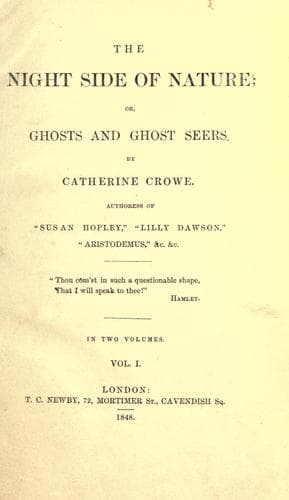
The Night-Side of Nature; Or, Ghosts and Ghost-SeersCrowe, Catherine
Religion
The Night-Side of Nature; Or, Ghosts and Ghost-Seers
Crowe, Catherine
Ghosts; Parapsychology
When Peter was released from prison by the angel—and it is not amiss
here to remark, that even he “wist not that it was true which was done
by the angel, but thought he saw a vision,” that is, he did not believe
his senses, but supposed himself the victim of a spectral illusion—but
when he was released, and went and knocked at the door of the gate,
where many of his friends were assembled, they, not conceiving it
possible he could have escaped, said, when the girl who had opened the
door insisted that he was there, “It is his angel.” What did they mean
by this? The expression is not _an_ angel, but _his_ angel. Now, it is
not a little remarkable, that in the East, to this day, a double, or
doppelgänger, is called a man’s angel, or messenger. As we can not
suppose that this term was used otherwise than seriously by the
disciples that were gathered together in Mark’s house, for they were in
trouble about Peter, and, when he arrived, were engaged in prayer, we
are entitled to believe they alluded to some recognised phenomenon. They
knew, either that the likeness of a man—his spiritual self—sometimes
appeared where bodily he was not; and that this _imago_ or _idolon_ was
capable of exerting a mechanical force, or else that other spirits
sometimes assumed a mortal form, or they would not have supposed it to
be Peter’s angel that had _knocked_ at the gate.
Dr. Ennemoser, who always leans to the physical rather than the
psychical explanation of a phenomenon, says, that the faculty of
self-seeing, which is analogous to seeing another person’s double, is to
be considered an illusion; but that this imago of another seen at a
distance, at the moment of death, must be supposed to have an objective
reality. But if we are capable of thus perceiving the imago of another
person, I can not comprehend why we may not see our own; unless, indeed,
the former was never perceived but when the body of the person seen was
in a state of insensibility; but this does not always seem to be a
necessary condition, as will appear by some examples I am about to
detail. The faculty of perceiving the object, Dr. Ennemoser considers
analogous to that of second sight, and thinks it may be evolved by
local, as well as idiosyncratical conditions. The difficulty arising
from the fact that some persons are in the habit of seeing the wraiths
of their friends and relations, must be explained by his hypothesis. The
spirit, as soon as liberated from the body, is adapted for communion
with _all_ spirits, embodied or otherwise; but all embodied spirits are
not prepared for communion with it.
Public-domain text, read in full here on John Shaqi.
Reviews
Reviews
No reviews yet
Be the first to share your thoughts on this work.
Elsewhere in the archive
Join the Discussion
Join the discussion
Sign in to leave a comment or review.
Sign InorCreate an account