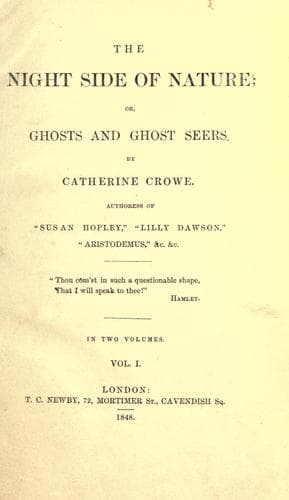
The Night-Side of Nature; Or, Ghosts and Ghost-SeersCrowe, Catherine
Religion
The Night-Side of Nature; Or, Ghosts and Ghost-Seers
Crowe, Catherine
Ghosts; Parapsychology
extraneous but inseparable from it; and I am very far from supposing
that my book is to settle the question even with a single mind. All I
hope or expect is to show that the question is not disposed of yet,
either by the rationalists or the physiologists, and that it is still an
open one; and all I desire is to arouse inquiry and curiosity, and that
thus some mind, better qualified than mine to follow out the
investigation, may be incited to undertake it.
Dr. Kerner mentions the case of a lady named Dillenius, who was awakened
one night by her son, a child six years of age; her sister-in-law, who
slept in the same room, also awoke at the same time, and all three saw
Madame Dillenius enter the room, attired in a black dress, which she had
lately bought. The sister said, “I see you double! you are in bed, and
yet you are walking about the room.” They were both extremely alarmed,
while the figure stood between the doors in a melancholy attitude with
the head leaning on the hand. The child—who also saw it, but seems not
to have been terrified—jumped out of bed, and running to the figure,
put his hand through it as he attempted to push it, exclaiming, “Go
away, you black woman.” The form, however, remained as before; and the
child, becoming alarmed, sprung into bed again. Madame Dillenius
expected that the appearance foreboded her own death; but that did not
ensue. A serious accident immediately afterward occurred to her husband,
and she fancied there might be some connection between the two events.
This is one of those cases which, from their extremely perplexing
nature, have induced some psychologists to seek an explanation in the
hypothesis that other spirits may for some purpose, or under certain
conditions, assume the form of a person with a view to giving an
intimation or impression, which the gulf separating the material from
the spiritual world renders it difficult to convey. As regards such
instances as that of Madame Dillenius, however, we are at a loss to
discover any motive—unless, indeed, it be sympathy—for such an
exertion of power, supposing it to be possessed. But in the famous case
of Catherine of Russia, who is said, while lying in bed, to have been
seen by the ladies to enter the throne-room, and, being informed of the
circumstance, went herself and saw the figure seated on the throne, and
bade her guards fire on it, we may conceive it possible that her
guardian-spirit, if such she had, might adopt this mode of warning her
to prepare for a change, which, after such a life as hers, we are
entitled to conclude she was not very fit to encounter.
Public-domain text, read in full here on John Shaqi.
Reviews
Reviews
No reviews yet
Be the first to share your thoughts on this work.
Elsewhere in the archive
Join the Discussion
Join the discussion
Sign in to leave a comment or review.
Sign InorCreate an account