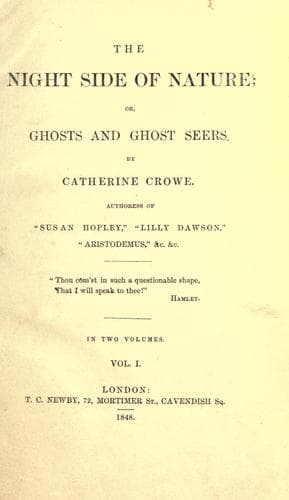
The Night-Side of Nature; Or, Ghosts and Ghost-SeersCrowe, Catherine
Religion
The Night-Side of Nature; Or, Ghosts and Ghost-Seers
Crowe, Catherine
Ghosts; Parapsychology
Dr. Paterson vouches for the truth of this story, and no doubt of its
being a mere illusion occurs to him, though the lady had never before or
since, as she assured him, been troubled with the malady. It seems to me
much more likely that, when the storm came on, the thoughts of the old
man would be intensely drawn homeward: he would naturally wish himself
in his comfortable arm-chair, and, knowing his young daughter to be
alone, he would inevitably feel some anxiety about her too. There was a
mutual projection of their spirits toward each other; and the one that
was most easily freed from its bonds, was seen where in the spirit it
actually was; for, as I have said above, a spirit out of the flesh, to
whom space is annihilated, must be where its thoughts and affections
are, for its thoughts and affections are _itself_.
I observe that Sir David Brewster and others, who have written on this
subject, and who represent all these phenomena as images projected on
the retina from the brain, dwell much on the fact that they are seen
alike, whether the eye be closed or open. There are, however, two
answers to be made to this argument: first, that even if it were so, the
proof would not be decisive, since it is generally with closed eyes that
somnambulic persons see, whether natural somnambules or magnetic
patients; and, secondly, I find in some instances, which appear to me to
be genuine cases of an objective appearance, that where the experiment
has been tried, the figure is not seen when the eyes are closed.
The author of a work entitled “An Inquiry into the Nature of Ghosts,”
who adopts the illusion theory, relates the following story, as one he
can vouch for, though not permitted to give the names of the parties:—
“Miss ——, at the age of seven years, being in a field not far from her
father’s house, in the parish of Kirklinton, in Cumberland, saw what she
thought was her father in the field, at a time that he was in bed, from
which he had not been removed for a considerable period. There were in
the field also, at the same moment, George Little, and John, his
fellow-servant. One of these cried out, ‘Go to your father, miss!’ She
turned round, and the figure had disappeared. On returning home, she
said, ‘Where is my father?’ The mother answered, ‘In bed, to be sure,
child!’—out of which he had not been.”
I quote this case, because the figure was seen by two persons. I could
mention several similar instances, but when only seen by one, they are,
of course, open to another explanation.
Public-domain text, read in full here on John Shaqi.
Reviews
Reviews
No reviews yet
Be the first to share your thoughts on this work.
Elsewhere in the archive
Join the Discussion
Join the discussion
Sign in to leave a comment or review.
Sign InorCreate an account