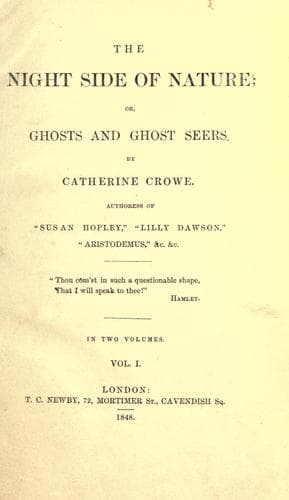
The Night-Side of Nature; Or, Ghosts and Ghost-SeersCrowe, Catherine
Religion
The Night-Side of Nature; Or, Ghosts and Ghost-Seers
Crowe, Catherine
Ghosts; Parapsychology
Well, then, supposing this being to exist somewhere—and it is not
unreasonable to suppose that the souls of the inhabitants of each planet
continue to hover within the sphere of that planet, to which, for
anything we can tell, they may be attached by a magnetic
attraction—supposing it to find itself in space, free of the body,
endowed with the memory of the past, and consequently with a
consciousness of its own deserts, able to perceive that which we do not
ordinarily perceive, namely, those who have passed into a similar state
with itself—will it not naturally seek its place among those spirits
which most resemble itself, and with whom, therefore, it must have the
most affinity? On earth, the good seek the good, and the wicked the
wicked: and the axiom that “like associates with like,” we can not doubt
will be as true hereafter as now. “In my Father’s house there are many
mansions,” and our intuitive sense of what is fit and just must needs
assure us that this is so. There are too many degrees of moral worth and
of moral unworth among mankind, to permit of our supposing that justice
could be satisfied by an abrupt division into two opposite classes. On
the contrary, there must be infinite shades of desert; and, as we must
consider that that which a spirit enters into on leaving the body is not
so much a _place_ as a _condition_, so there must be as many degrees of
happiness or suffering as there are individuals, each carrying with him
his own heaven or hell. For it is a vulgar notion to imagine that heaven
and hell are _places_; they are states; and it is in ourselves we must
look for both. When we leave the body, we carry them with us: “As the
tree falls, so it shall lie.” The soul which here has wallowed in
wickedness or been sunk in sensuality, will not be suddenly purified by
the death of the body: its moral condition remains what its earthly
sojourn has trained it to, but its means of indulging its propensities
are lost. If it has had no godly aspirations here, it will not be drawn
to God there; and if it has so bound itself to the body that it has
known no happiness but that to which the body ministered, it will be
incapable of happiness when deprived of that enjoyment. Here we see at
once what a variety of conditions must necessarily ensue—how many
comparatively negative states there must be between those of positive
happiness or positive misery!
Public-domain text, read in full here on John Shaqi.
Reviews
Reviews
No reviews yet
Be the first to share your thoughts on this work.
Elsewhere in the archive
Join the Discussion
Join the discussion
Sign in to leave a comment or review.
Sign InorCreate an account