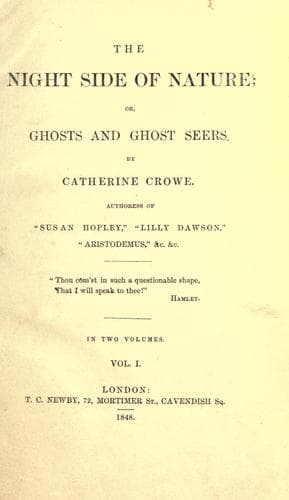
The Night-Side of Nature; Or, Ghosts and Ghost-SeersCrowe, Catherine
Religion
The Night-Side of Nature; Or, Ghosts and Ghost-Seers
Crowe, Catherine
Ghosts; Parapsychology
The circumstance, too, that phenomena of this kind are more frequently
developed in women than in men, and that they are merely the consequence
of her greater nervous irritability, has been made another objection to
them—an objection, however, which Dr. Passavent considers founded on
ignorance of the essential difference between the sexes, which is not
merely a physical but a psychological one. Man is more productive than
receptive. In a state of perfectibility, both attributes would be
equally developed in him; but in this terrestrial life, only imperfect
phases of the entire sum of the soul’s faculties are so. Mankind are but
children, male or female, young or old; of man, in his totality, we have
but faint adumbrations, here and there.
Thus the ecstatic woman will be more frequently a seer, instinctive and
intuitive; man, a doer and a worker; and as all genius is a degree of
ecstasy or clear-seeing, we perceive the reason wherefore in man it is
more productive than in woman, and that our greatest poets and artists,
in all kinds, are of the former sex, and even the most remarkable women
produce but little in science or art; while on the other hand, the
feminine instinct, and tact, and intuitive seeing of truth, are
frequently more sure than the ripe and deliberate judgment of man; and
it is hence that solitude and such conditions as develop the passive or
receptive at the expense of the active, tend to produce this state, and
to assimilate the man more to the nature of the woman; while in her they
intensify these distinguishing characteristics; and this is also the
reason that simple and child-like people and races are the most frequent
subjects of these phenomena.
It is only necessary to read Mozart’s account of his own moments of
inspiration, to comprehend not only the similarity, but the positive
identity, of the ecstatic state with the state of genius in activity.
“When all goes well with me,” he says—“when I am in a carriage, or
walking, or when I can not sleep at night, the thoughts come streaming
in upon me most fluently: whence, or how, is more than I can tell. What
comes, I hum to myself as it proceeds. Then follow the counterpoint and
the clang of the different instruments; and, if I am not disturbed, my
soul is fixed, and the thing grows greater, and broader, and clearer;
and I have it all in my head, even when the piece is a long one; and I
see it like a beautiful picture—not hearing the different parts in
succession as they must be played, but the whole at once. That is the
delight! The composing and the making is like a beautiful and vivid
dream; but this hearing of it is the best of all.”
Public-domain text, read in full here on John Shaqi.
Reviews
Reviews
No reviews yet
Be the first to share your thoughts on this work.
Elsewhere in the archive
Join the Discussion
Join the discussion
Sign in to leave a comment or review.
Sign InorCreate an account