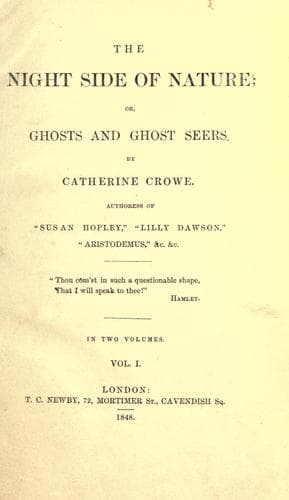
The Night-Side of Nature; Or, Ghosts and Ghost-SeersCrowe, Catherine
Religion
The Night-Side of Nature; Or, Ghosts and Ghost-Seers
Crowe, Catherine
Ghosts; Parapsychology
periods too strong to be wholly rejected; so that even the materialists,
like Lucretius and the elder Pliny, find themselves obliged to
acknowledge them; while, on the other hand, the extravagant admissions
that are demanded of us by those who endeavor to explain them away,
prove that their disbelief rests on no more solid foundation than their
own prejudices. I acknowledge all the difficulty of establishing the
facts—such difficulties as indeed encompass few other branches of
inquiry; but I maintain that the position of the opponents is still
worse, although, by their high tone and contemptuous laugh, they assume
to have taken up one that, being fortified by reason, is quite
impregnable, forgetting that the wisdom of man is pre-eminently
“foolishness before God,” when it wanders into this region of unknown
things;—forgetting, also, that they are just serving this branch of
inquiry, as their predecessors, whom they laughed at, did physiology;
concocting their systems out of their own brains, instead of the
responses of nature—and with still more rashness and presumption, this
department of her kingdom being more inaccessible, more incapable of
demonstration, and more entirely beyond our control; for these spirits
will not “come when we do call them;”—and I confess it often surprises
me to hear the very shallow nonsense that very clever men talk upon the
subject, and the inefficient arguments they use to disprove what they
know nothing about. I am quite conscious that the facts I shall adduce
are open to controversy: I can bring forward no evidence that will
satisfy a scientific mind; but neither are my opponents a whit better
fortified. All I do hope to establish is, not a proof, but a
presumption; and the conviction I desire to awaken in people’s minds is,
not that these things _are_ so, but that they _may be_ so, and that it
is well worth our while to inquire whether they are or not.
It will be seen that these views of a future state are extremely similar
to those of Isaac Taylor, as suggested in his physical theory of another
life—at least, as far as he has entered upon the subject;—and it is
natural that they should be so, because he seems also to have been a
convert to the opinion that “the dead do sometimes break through the
boundaries that hem in the ethereal crowds; and if so, as if by
trespass, may in single instances infringe upon the ground of common
corporeal life.”
Public-domain text, read in full here on John Shaqi.
Reviews
Reviews
No reviews yet
Be the first to share your thoughts on this work.
Elsewhere in the archive
Join the Discussion
Join the discussion
Sign in to leave a comment or review.
Sign InorCreate an account