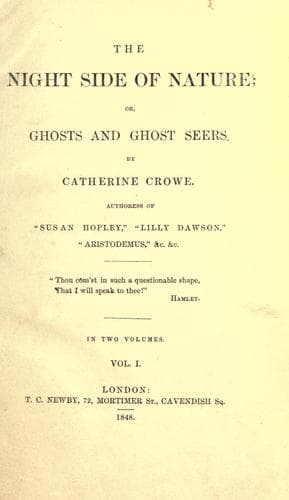
The Night-Side of Nature; Or, Ghosts and Ghost-SeersCrowe, Catherine
Religion
The Night-Side of Nature; Or, Ghosts and Ghost-Seers
Crowe, Catherine
Ghosts; Parapsychology
Now, if we admit the probability of this middle state, we have removed
one of the great objections which are made to the belief in the
reappearance of the dead: namely, that the blest are too happy to return
to the earth, and that the wicked have it not in their power to do so.
This difficulty arises, however, very much from the material ideas
entertained of heaven and hell—the notion that they are places instead
of states. I am told that the Greek word _hades_ is derived from
_æides_, _invisible_; and that the Hebrew word _scheôl_, which has the
same signification, also implies a state, not a place, since it may be
interpreted into _desiring_, _longing_, _asking_, _praying_. These words
in the Septuagint are translated _grave_, _death_, and _hell_; but
previously to the Reformation they seem to have borne their original
meaning—that is, the state into which the soul entered at the death of
the body. It was probably to get rid of the purgatory of the Roman
Church, which had doubtless become the source of many absurd notions and
corrupt practices, that the doctrine of a middle state or hades was set
aside: besides which, the honest desire for reformation, in all
reforming churches, being alloyed by the _odium theologicum_, the
purifying besom is apt to take too discursive a sweep, exercising less
modesty and discrimination than might be desirable, and thus not
uncommonly wiping away truth and falsehood together.
Dismissing the idea, therefore, that heaven and hell are places in which
the soul is imprisoned, whether in bliss or woe, and supposing that, by
a magnetic relation, it may remain connected with the sphere to which it
previously belonged, we may easily conceive that, if it have the memory
of the past, the more entirely sensuous its life in the body may have
been, the closer it will cling to the scene of its former joys; or even
if its sojourn on earth were not a period of joy, but the contrary,
still, if it have no heavenward aspirations, it will find itself, if not
in actual wo, yet aimless, objectless, and out of a congenial element.
It has no longer the organs whereby it perceived, communicated with, and
enjoyed, the material world and its pleasures. The joys of heaven are
not its joys; we might as well expect a hardened prisoner in Newgate,
associating with others as hardened as himself, to melt into ecstatic
delight at the idea of that which he can not apprehend! How helpless and
inefficient such a condition seems! and how natural it is to us to
imagine that, under such circumstances, there might be awakened a
considerable desire to manifest itself to those yet living in the flesh,
if such a manifestation be possible! And what right have we, in direct
contradiction to all tradition, to assert that it is not? We may raise
up a variety of objections from physical science, but we can not be sure
that these are applicable to the case; and of the laws of spirit we know
very little, since we are only acquainted with it as circumscribed,
Public-domain text, read in full here on John Shaqi.
Reviews
Reviews
No reviews yet
Be the first to share your thoughts on this work.
Elsewhere in the archive
Join the Discussion
Join the discussion
Sign in to leave a comment or review.
Sign InorCreate an account