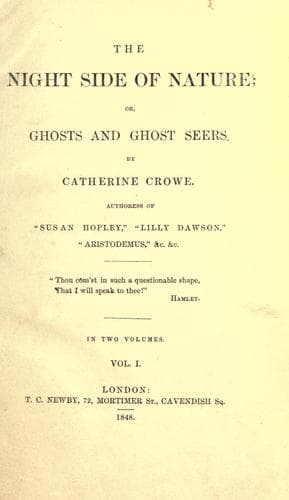
The Night-Side of Nature; Or, Ghosts and Ghost-SeersCrowe, Catherine
Religion
The Night-Side of Nature; Or, Ghosts and Ghost-Seers
Crowe, Catherine
Ghosts; Parapsychology
Now, I ask if this is a fair way of treating any fact, transmitted to us
on authority which the objector himself admits to be perfectly
satisfactory—more especially as the assistants on the occasion appear
to have been quite as unwilling to believe in the _supernatural_
interpretation of it as Dr. Hibbert could have been himself, had he been
present; for what more could he have done than conclude the young lady
to be mad, and bled her?—a line of practice which is precisely what
would be followed at the present time, and which proves that they were
very well aware of the sensuous illusions produced by a disordered state
of the nervous system; and with respect to his conclusion that the
“languishing female” contributed to the verification of the prediction,
we are entitled to ask, where is the proof that she was languishing? A
very clever watchmaker once told me that a watch may go perfectly well
for years, and at length stop suddenly, in consequence of an organic
defect in its construction, which only becomes perceptible, even to the
eye of a watchmaker, when this effect takes place; and we do know that
many persons have suddenly fallen dead immediately after declaring
themselves in the best possible health: and we have therefore no right
to dispute what the narrator implies, namely, that there were no
sensible indications of the impending catastrophe.
There was either some organic defect or derangement in this lady’s
physical economy, which rendered her death inevitable at the hour of
noon, on that particular Thursday, or there was not. If there was, and
her certain death was impending at that hour, how came she acquainted
with the fact? Surely it is a monstrous assumption to say that it was “a
fortunate coincidence,” when no reason whatever is given us for
concluding that she felt otherwise than perfectly well! If, on the
contrary, we are to take refuge in the supposition that there was no
death impending, and that she only died of the fright, how came
she—feeling perfectly well, and, in this case, we have a right to
conclude _being_ perfectly well—to be the subject of such an
extraordinary spectral illusion? And if such spectral illusions can
occur to people in a good normal state of health, does it not become
very desirable to give us some clearer theory of them than we have at
present?
Public-domain text, read in full here on John Shaqi.
Reviews
Reviews
No reviews yet
Be the first to share your thoughts on this work.
Elsewhere in the archive
Join the Discussion
Join the discussion
Sign in to leave a comment or review.
Sign InorCreate an account