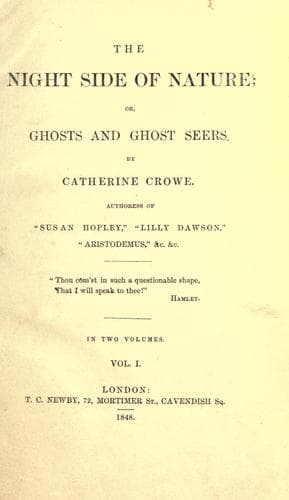
The Night-Side of Nature; Or, Ghosts and Ghost-SeersCrowe, Catherine
Religion
The Night-Side of Nature; Or, Ghosts and Ghost-Seers
Crowe, Catherine
Ghosts; Parapsychology
It seems also to be gathered from experience, that those whose lives
have been rendered wretched, “rest not in their graves;” at least,
several accounts I have met with, as well as tradition, countenance this
view; and this may originate in the fact that cruelty and ill-usage
frequently produce very pernicious effects on the mind of the sufferer,
in many instances inspiring, not resignation or a pious desire for
death, but resentment, and an eager longing for a fair share of earthly
enjoyment. Supposing, also, the feelings and prejudices of the earthly
life to accompany this dispossessed soul—for, though the liberation
from the body inducts it into certain privileges inherent in spirit, its
moral qualities remain as they were (“as the tree falls, so it shall
lie”)—supposing, therefore, that these feelings, and prejudices, and
recollections, of its past life, are carried with it, we see at once why
the discontented spirits of the heathen world could not rest till their
bodies had obtained sepulture, why the buried money should torment the
soul of the miser, and why the religious opinions, whatever they may
have been, believed in the flesh, seem to survive with the spirit. There
are two remarkable exceptions, however, and these are precisely such as
might be expected. Those who, during their corporeal life, have not
believed in a future state, return to warn their friends against the
same error. “There is another world!” said the brother of the young lady
who appeared to her in the cathedral of York, on the day he was drowned;
and there are several similar instances recorded. The belief that this
life “is the be-all and the end-all here,” is a mistake that death must
instantly rectify. The other exception I allude to is, that that
toleration, of which, unfortunately, we see much less than is desirable
in this world, seems happily to prevail in the next; for, among the
numerous narrations I meet with, in which the dead have returned to ask
the prayers or the services of the living, they do not seem, as will be
seen by-and-by, to apply by any means exclusively to members of their
own church. The _attrait_ which seems to guide their selection of
individuals is evidently not of a polemical nature. The pure worship of
God, and the inexorable moral law, are what seem to prevail in the other
world, and not the dogmatic theology which makes so much of the misery
of this.
There is a fundamental truth in all religions: the real end of all is
morality, however the means may be mistaken, and however corrupt,
selfish, ambitious, and sectarian, the mass of their teachers may and
generally do become; while the effect of prayer—in whatever form, or to
whatever ideal of the Deity it may be offered, provided that offering be
honestly and earnestly made—is precisely the same to the supplicant and
in its results.
Public-domain text, read in full here on John Shaqi.
Reviews
Reviews
No reviews yet
Be the first to share your thoughts on this work.
Elsewhere in the archive
Join the Discussion
Join the discussion
Sign in to leave a comment or review.
Sign InorCreate an account