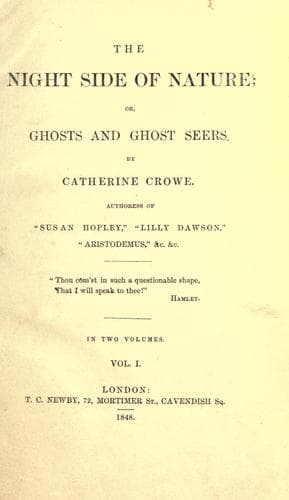
The Night-Side of Nature; Or, Ghosts and Ghost-SeersCrowe, Catherine
Religion
The Night-Side of Nature; Or, Ghosts and Ghost-Seers
Crowe, Catherine
Ghosts; Parapsychology
Monsieur De S. had been violently in love with Hippolyte Clairon, the
celebrated French actress, but she rejected his suit, in so peremptory a
manner, that even when he was at the point of death, she refused his
earnest entreaties, that she would visit him. Indignant at her cruelty,
he declared that he would haunt her, and he certainly kept his word. I
believe she never saw his ghost, but he appears to have been always near
her; at least, on several occasions when other people doubted the fact,
he signalized his presence at her bidding, by various sounds, and this,
wherever she happened to be at the moment. Sometimes it was a cry, at
others, a shot, and at others, a clapping of hands or music. She seems
to have been slow to believe in the extra-natural character of these
noises; and even when she was ultimately convinced, to have been divided
between horror on the one hand, and diversion, at the oddness of the
circumstance, on the other. The sounds were heard by everybody in her
vicinity; and I am informed by Mr. Charles Kirkpatrick Sharpe, that the
margrave of Anspach, who was subsequently her lover, and Mr. Keppel
Craven, were perfectly well acquainted with the circumstances of this
haunting, and entertained no doubt of the facts above alluded to.
The ghost known by the designation of “the White Lady,” which is
frequently seen in different castles or palaces belonging to the royal
family of Prussia, has been mentioned in another publication, I think.
She was long supposed to be a Countess Agnes, of Orlamunde; but a
picture of a princess called Bertha, or Perchta von Rosenberg,
discovered some time since, was thought so exceedingly to resemble the
apparition, that it is now a disputed point which of the two ladies it
is, or whether it is or is not the same apparition that is seen at
different places. Neither of these ladies appears to have been very
happy in their lives: but the opinion of its being the Princess Bertha,
who lived in the fifteenth century, was somewhat countenanced by the
circumstance, that at a period when, in consequence of the war, an
annual benefit which she had bequeathed to the poor was neglected, the
apparition seemed to be unusually disturbed, and was seen more
frequently. She is often observed before a death; and one of the
Fredericks said, shortly before his decease, that he should “not live
long, for he had met the White Lady.” She wears a widow’s band and veil,
but it is sufficiently transparent to show her features, which do not
express happiness, but placidity. She has only been twice heard to
speak. In December, 1628, she appeared in the palace at Berlin, and was
heard to say, “_Veni, judica vivos et mortuos! Judicium mihi adhuc
superest._”—“Come, judge the quick and the dead! I wait for judgment.”
On the other occasion, which is more recent, one of the princesses at
the castle of Neuhaus, in Bohemia, was standing before a mirror, trying
on a new head-dress, when, on asking her waiting-maid what the hour was,
Public-domain text, read in full here on John Shaqi.
Reviews
Reviews
No reviews yet
Be the first to share your thoughts on this work.
Elsewhere in the archive
Join the Discussion
Join the discussion
Sign in to leave a comment or review.
Sign InorCreate an account