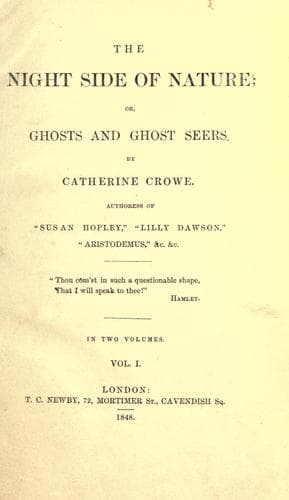
The Night-Side of Nature; Or, Ghosts and Ghost-SeersCrowe, Catherine
Religion
The Night-Side of Nature; Or, Ghosts and Ghost-Seers
Crowe, Catherine
Ghosts; Parapsychology
But, although the above phenomena seem to be equally well known in all
countries, there is one peculiar class of apparitions of which I meet
with no records but in Germany. I allude to ghosts, who, like those
described in the “Seeress of Prevorst,” seek the prayers of the living.
In spite of the positive assertions of Kerner, Eschenmayer, and others,
that after neglecting no means to investigate the affair, they had been
forced into the conviction that the spectres that frequented Frederica
Hauffe were not subjective illusions, but real outstanding forms, still,
as she was in the somnambulic state, many persons remain persuaded that
the whole thing was delusion. It is true, that as those parties were not
there, and as all those who did go to the spot came to a different
conclusion, this opinion being only the result of preconceived notions
or prejudices, and not of calm investigation, is of no value whatever;
nevertheless, it is not to be denied that these narrations are very
extraordinary; but, perplexing as they are, they by no means stand
alone. I find many similar ones noticed in various works, where there
has been no somnambule in question. In all cases, these unfortunate
spirits appear to have been waiting for some one with whom they could
establish a rapport, so as to be able to communicate with them; and this
waiting has sometimes endured a century or more. Sometimes they are seen
by only one person, at other times by several, with varying degrees of
distinctness, appearing to one as a light, to another as a shadowy
figure, and to a third as a defined human form. Other testimonies of
their presence—as sounds, footsteps, lights, visible removing of solid
articles without a visible agent, odors, &c.—are generally perceived by
many; in short, the sounds seem audible to all who come to the spot,
with the exception of the voice, which in most instances is only heard
by the person with whom the rapport is chiefly established. Some cases
are related, where a mark like burning is left on the articles seen to
be lifted. This is an old persuasion, and has given rise to many a joke.
But, upon the hypothesis I have offered, the thing is simple enough: the
mark will probably be of the same nature as that left by the electrical
fluid;—and it is this particular, and the lights that often accompany
spirits, that have caused the notion of material flames, sulphur,
brimstone, &c., to be connected with the idea of a future state.
According to our views, there can be no difficulty in conceiving that a
happy and blessed spirit would emit a mild radiance; while anger or
malignity would necessarily alter the character of the effulgence.
As whoever wishes to see a number of these cases may have recourse to my
translation of the “Seeress of Prevorst,” I will here only relate one,
of a very remarkable nature, that occurred in the prison of Weinsberg,
in the year 1835.
Public-domain text, read in full here on John Shaqi.
Reviews
Reviews
No reviews yet
Be the first to share your thoughts on this work.
Elsewhere in the archive
Join the Discussion
Join the discussion
Sign in to leave a comment or review.
Sign InorCreate an account