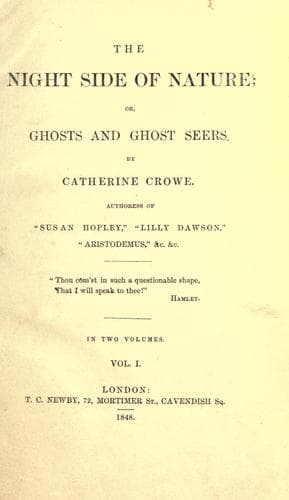
The Night-Side of Nature; Or, Ghosts and Ghost-SeersCrowe, Catherine
Religion
The Night-Side of Nature; Or, Ghosts and Ghost-Seers
Crowe, Catherine
Ghosts; Parapsychology
Ennemoser and Schubert believe, that the instinct by which animals seek
their food, consists in polarity, but I have met with only two modern
theories which pretend to explain the phenomena of presentiment; the one
is, that the person is in a temporarily magnetic state, and that the
presentiment is a kind of clairvoyance. That the faculty, like that of
prophetic dreaming, is constitutional, and chiefly manifested in certain
families, is well established; and the very unimportant events, such as
visits, and so forth, on which it frequently exercises itself, forbid us
to seek an explanation in a higher source. It seems, also, to be quite
independent of the will of the subject, as it was in the case of
Zschokke, who found himself thus let into the secrets of persons in whom
he felt no manner of interest, while, where the knowledge might have
been of use to him, he could not command it. The theory of one half of
the brain in a negative state, serving as a mirror to the other half, if
admitted at all, may answer as well, or better, for these waking
presentiments, than for clear-seeing in dreams. But, for my own part, I
incline very much to the views of that school of philosophers who adopt
the first and more spiritual theory, which seems to me to offer fewer
difficulties, while, as regards our present nature, and future hopes, it
is certainly more satisfactory. Once admitted that the body is but the
temporary dwelling of an immaterial spirit, the machine through which,
and by which, in its normal states, the spirit alone can manifest
itself, I can not see any great difficulty in conceiving that, in
certain conditions of that body, their relations may be modified, and
that the spirit may perceive, by its own inherent quality, without the
aid of its material vehicle; and, as this condition of the body may
arise from causes purely physical, we see at once why the revelations
frequently regard such unimportant events.
Plutarch, in his dialogue between Lamprius and Ammonius, observes, that
if the demons, or protecting spirits, that watch over mankind, are
disembodied souls, we ought not to doubt that those spirits, even when
in the flesh, possessed the faculties they now enjoy, since we have no
reason to suppose that any new ones are conferred at the period of
dissolution; for these faculties must be inherent, although temporarily
obscured, and weak and ineffective in their manifestations. As it is not
when the sun breaks from behind the clouds that he first begins to
shine, so it is not when the soul issues from the body, as from a cloud
that envelops it, that it first attains the power of looking into the
future.
Public-domain text, read in full here on John Shaqi.
Reviews
Reviews
No reviews yet
Be the first to share your thoughts on this work.
Elsewhere in the archive
Join the Discussion
Join the discussion
Sign in to leave a comment or review.
Sign InorCreate an account