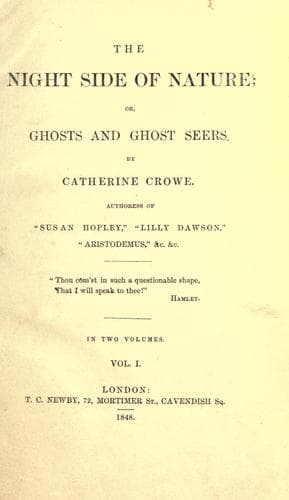
The Night-Side of Nature; Or, Ghosts and Ghost-SeersCrowe, Catherine
Religion
The Night-Side of Nature; Or, Ghosts and Ghost-Seers
Crowe, Catherine
Ghosts; Parapsychology
But the events foreseen are not always unimportant, nor is the mode of
the communication always of the same nature. I have mentioned above some
instances wherein danger was avoided, and there are many of the same
kind recorded in various works; and it is the number of instances of
this description, corroborated by the universal agreement of all
somnambulists of a higher order, which has induced a considerable
section of the German psychologists to adopt the doctrine of guardian
spirits—a doctrine which has prevailed, more or less, in all ages, and
has been considered by many theologians to be supported by the Bible.
There is in this country, and I believe in France, also, though with
more exceptions, such an extreme aversion to admit the possibility of
anything like what is called supernatural agency, that the mere avowal
of such a persuasion is enough to discredit one’s understanding with a
considerable part of the world, not excepting those who profess to
believe in the Scriptures. Yet, even apart from this latter authority, I
can not see anything repugnant to reason in such a belief. As far as we
see of nature, there is a continued series from the lowest to the
highest; and what right have we to conclude that we are the last link of
the chain? Why may there not be a gamut of beings? That such should be
the case, is certainly in accordance with all that we see; and that we
do not see them, affords, as I have said above, not a shadow of argument
against their existence; man, immersed in business and pleasure, living
only his sensuous life, is too apt to forget how limited those senses
are, how merely designed for a temporary purpose, and how much may exist
of which they can take no cognizance.
The _possibility_ admitted, the chief arguments against the
_probability_ of such a guardianship, are the interference it implies
with the free-will of man, on the one hand, and the rarity of this
interference, on the other. With respect to the first matter of
free-will, it is a subject of acknowledged difficulty, and beyond the
scope of my work. Nobody can honestly look back upon his past life
without feeling perplexed by the question, of how far he was, or was
not, able at the moment to resist certain impulsions, which caused him
to commit wrong or imprudent actions; and it must, I fear, ever remain a
_quæstio vexata_, how far our virtues and vices depend upon our
organization—an organization whose constitution is beyond our own
power, in the first instance, although we may certainly improve or
deteriorate it; but which we must admit, at the same time, to be, in its
present deteriorated form, the ill result of the world’s corruption, and
the inherited penalty of the vices of our predecessors, whereby the sins
of the fathers are visited upon the children unto the third and fourth
generation.
Public-domain text, read in full here on John Shaqi.
Reviews
Reviews
No reviews yet
Be the first to share your thoughts on this work.
Elsewhere in the archive
Join the Discussion
Join the discussion
Sign in to leave a comment or review.
Sign InorCreate an account