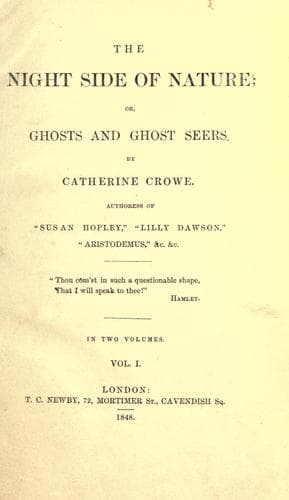
The Night-Side of Nature; Or, Ghosts and Ghost-SeersCrowe, Catherine
Religion
The Night-Side of Nature; Or, Ghosts and Ghost-Seers
Crowe, Catherine
Ghosts; Parapsychology
There is, as the Scriptures say, but one way to salvation, though there
are many to perdition—that is, though there are many wrongs, there is
only one right; for truth is one, and our true liberty consists in being
free to follow it; for we can not imagine that anybody seeks his own
perdition, and nobody, I conceive, loves vice for its own sake, as
others love virtue, that is, because it _is_ vice: so that, when they
follow its dictates, we must conclude that they are not free, but in
bondage, whose ever bond-slave they be, whether of an evil spirit, or of
their own organization; and I think every human being, who looks into
himself, will feel that he is in effect then only _free_ when he is
obeying the dictates of virtue; and that the language of Scripture,
which speaks of sin as a bondage, is not only metaphorically but
literally true.
The warning a person of an impending danger or error implies no
constraint; the subject of the warning is free to take the hint or not,
as he pleases; we receive many cautions, both from other people and from
our own consciences, which we refuse to benefit by.
With regard to the second objection, it seems to have greater weight;
for although the instances of presentiment are very numerous, taken
apart, they are certainly, as far as we know, still but exceptional
cases. But here we must remember that an influence of this sort might be
very continuously, though somewhat remotely, exercised in favor of an
individual, without the occurrence of any instance of so striking a
nature as to render the interference manifest; and certain it is that
some people—I have met with several, and very sensible persons
too—have all their lives an intuitive persuasion of such a guardianship
existing in relation to themselves. That in our normal states it was not
intended we should hold sensible communion with the invisible world,
seems evident; but nature abounds in exceptions; and there may be
conditions regarding both parties, the incorporated and the
unincorporated spirit, which may at times bring them into a more
intimate relation. No one who believes that consciousness is to survive
the death of the body, can doubt that the released spirit will then hold
communion with its congeners; it being the fleshly tabernacles we
inhabit which alone disables us from doing so at present. But since the
constitutions of bodies vary exceedingly, not only in different
individuals, but in the same individuals at different times, may we not
conceive the possibility of there existing conditions which, by
diminishing the obstructions, render this communion practicable within
certain limits? For there certainly are recorded and authentic instances
of presentiments and warnings, that with difficulty admit of any other
explanation; and that these admonitions are more frequently received in
the state of sleep than of vigilance, rather furnishes an additional
argument in favor of the last hypothesis; for if there be any foundation
Public-domain text, read in full here on John Shaqi.
Reviews
Reviews
No reviews yet
Be the first to share your thoughts on this work.
Elsewhere in the archive
Join the Discussion
Join the discussion
Sign in to leave a comment or review.
Sign InorCreate an account