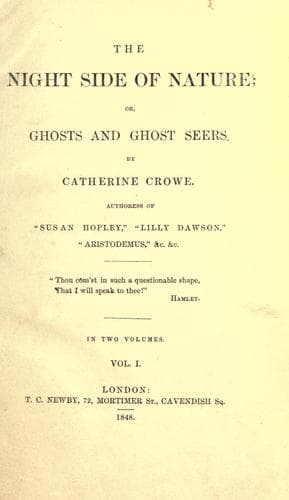
The Night-Side of Nature; Or, Ghosts and Ghost-SeersCrowe, Catherine
Religion
The Night-Side of Nature; Or, Ghosts and Ghost-Seers
Crowe, Catherine
Ghosts; Parapsychology
Being an excellent swimmer, and the distance from the shore
inconsiderable, he hoped to save himself, but he had on a heavy
top-coat, with boots and spurs. The coat he contrived to take off in the
water, and then struck out with confidence; but, alas! the coat had got
entangled with one of the spurs, and, as he swam, it clung to him,
getting heavier and heavier as it became saturated with water, ever
dragging him beneath the stream. He, however, reached the shore, where
his anxious friend still stood watching the event; and, as the latter
bent over him, he was just able to make a gesture with his hand, which
seemed to say, “You see, it was to be!” and then expired.
The boatman was also drowned; but, by the aid of the horse, the servant
escaped.
As I do not wish to startle my readers, nor draw too suddenly on their
faith, I have commenced with this class of phenomena, which it must be
admitted are sufficiently strange, and, if true, must also be admitted
to be well worthy of attention. No doubt these cases, and still more
those to which I shall next proceed, give a painful shock to the
received notions of polished and educated society in general—especially
in this country, where the analytical or scientifical psychology of the
eighteenth century has almost superseded the study of synthetic or
philosophical psychology. It has become a custom to look at all the
phenomena regarding man in a purely physiological point of view; for
although it is admitted that he has a mind, and although there is such a
science as metaphysics, the existence of what we call _mind_ is never
considered but as connected with the body. We know that body can exist
without mind; for, not to speak of certain living conditions, the body
subsists without mind when the spirit has fled; albeit, without the
living principle it can subsist but for a short period, except under
particular circumstances; but we seem to have forgotten that mind,
though dependent upon body as long as the connection between them
continues, can yet subsist without it. There have indeed been
philosophers, purely materialistic, who have denied this, but they are
not many; and not only the whole Christian world, but all who believe in
a future state, must perforce admit it; for even those who hold that
most unsatisfactory doctrine that there will be neither memory nor
consciousness till a second incorporation takes place, will not deny
that the mind, however in a state of abeyance and unable to manifest
itself, must still subsist as an inherent property of man’s immortal
part. Even if, as some philosophers believe, the spirit, when freed from
the body by death, returns to the Deity and is reabsorbed in the being
of God, not to become again a separate entity until reincorporated,
still what we call mind can not be disunited from it. And when once we
have begun to conceive of mind, and consequently of perception, as
separated from and independent of bodily organs, it will not be very
Public-domain text, read in full here on John Shaqi.
Reviews
Reviews
No reviews yet
Be the first to share your thoughts on this work.
Elsewhere in the archive
Join the Discussion
Join the discussion
Sign in to leave a comment or review.
Sign InorCreate an account