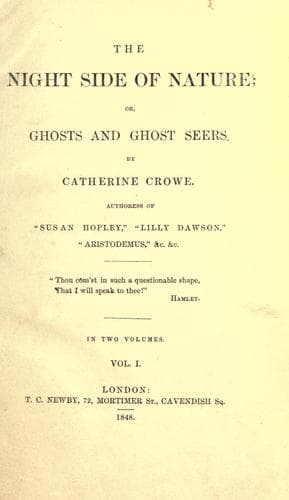
The Night-Side of Nature; Or, Ghosts and Ghost-SeersCrowe, Catherine
Religion
The Night-Side of Nature; Or, Ghosts and Ghost-Seers
Crowe, Catherine
Ghosts; Parapsychology
All such phenomena, Dr. Passavent attributes to the interaction of
imponderables—or of one universal imponderable under different
manifestations—which acts not only within the organism, but beyond it,
independently of all material obstacles; just as a sympathy appears
between one organ and another, unobstructed by the intervening ones; and
he instances the sympathy which exists between the mother and the fœtus,
as an example of this sort of double life, and standing as midway
between the sympathy between two organs in the same body and that
between two separate bodies, each having its own life, and its life also
in and for another, as parts of one whole. The sympathy between a bird
and the eggs it sits upon, is of the same kind; many instances having
been observed, wherein eggs, taken from one bird and placed under
another, have produced a brood feathered like the foster instead of the
real parent.
Thus, this vital force may extend dynamically the circle of its
influence, till, under favorable circumstances, it may act on other
organisms, making their organs its own.
I need scarcely remind my readers of the extraordinary sympathies
manifested by the Siamese twins, Chang and Eng. I never saw them myself;
and, for the benefit of others in the same situation, I quote the
following particulars from Dr. Passavent: “They were united by a
membrane which extended from the breast-bone to the navel; but, in other
respects, were not different from their countrymen in general. They were
exceedingly alike, only that Eng was rather the more robust of the two.
Their pulsations were not always coincident. They were active and agile,
and fond of bodily exercises; their intellects were well developed, and
their tones of voice and accent were precisely the same. As they never
conversed together, they had nearly forgotten their native tongue. If
one was addressed, they both answered. They played some games of skill,
but never with each other; as that, they said, would have been like the
right hand playing with the left. They read the same book at the same
time, and sang together in unison. In America they had a fever, which
ran precisely a similar course with each. Their hunger, thirst,
sleeping, and waking, were alway coincident, and their tastes and
inclinations were identical. Their movements were so simultaneous, that
it was impossible to distinguish with which the impulse had originated;
they appeared to have but one will. The idea of being separated by an
operation was abhorrent to them; and they consider themselves much
happier in their duality than are the individuals who look upon them
with pity.”
Public-domain text, read in full here on John Shaqi.
Reviews
Reviews
No reviews yet
Be the first to share your thoughts on this work.
Elsewhere in the archive
Join the Discussion
Join the discussion
Sign in to leave a comment or review.
Sign InorCreate an account