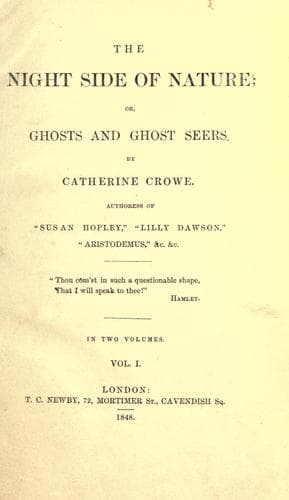
The Night-Side of Nature; Or, Ghosts and Ghost-SeersCrowe, Catherine
Religion
The Night-Side of Nature; Or, Ghosts and Ghost-Seers
Crowe, Catherine
Ghosts; Parapsychology
I shall return to these mysterious influences by-and-by; but to revert,
in the meanwhile, to the subject of double dreams, I will relate one
that occurred to two ladies, a mother and daughter, the latter of whom
related it to me. They were sleeping in the same bed at Cheltenham, when
the mother, Mrs. C——, dreamed that her brother-in-law, then in
Ireland, had sent for her; that she entered his room, and saw him in
bed, apparently dying. He requested her to kiss him, but, owing to his
livid appearance, she shrank from doing so, and awoke with the horror of
the scene upon her. The daughter awoke at the same moment, saying, “Oh,
I have had such a frightful dream!” “Oh, so have I!” returned the
mother; “I have been dreaming of my brother-in-law!”—“My dream was
about him, too,” added Miss C——. “I thought I was sitting in the
drawing-room, and that he came in wearing a shroud, trimmed with black
ribands, and, approaching me, he said: ‘My dear niece, your mother has
refused to kiss me, but I am sure you will not be so unkind!’”
As these ladies were not in habits of regular correspondence with their
relative, they knew that the earliest intelligence likely to reach them,
if he were actually dead, would be by means of the Irish papers; and
they waited anxiously for the following Wednesday, which was the day
these journals were received in Cheltenham. When that morning arrived,
Miss C—— hastened at an early hour to the reading-room, and there she
learned what the dreams had led them to expect: their friend was dead;
and they afterward ascertained that his decease had taken place on that
night. They moreover observed, that neither one nor the other of them
had been speaking or thinking of this gentleman for some time previous
to the occurrence of the dreams; nor had they any reason whatever for
uneasiness with regard to him. It is a remarkable peculiarity in this
case, that the dream of the daughter appears to be a continuation of
that of the mother. In the one, he is seen alive; in the other, the
shroud and black ribands seem to indicate that he is dead, and he
complains of the refusal to give him a farewell kiss.
One is almost inevitably led here to the conclusion that the thoughts
and wishes of the dying man were influencing the sleepers, or that the
released spirit was hovering near them.
Pomponius Mela relates, that a certain people in the interior of Africa
lay themselves down to sleep on the graves of their forefathers, and
believe the dreams that ensue to be the unerring counsel of the dead.
Public-domain text, read in full here on John Shaqi.
Reviews
Reviews
No reviews yet
Be the first to share your thoughts on this work.
Elsewhere in the archive
Join the Discussion
Join the discussion
Sign in to leave a comment or review.
Sign InorCreate an account