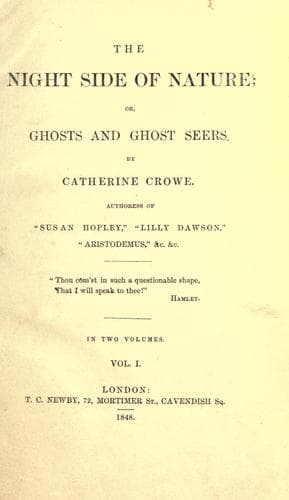
The Night-Side of Nature; Or, Ghosts and Ghost-SeersCrowe, Catherine
Religion
The Night-Side of Nature; Or, Ghosts and Ghost-Seers
Crowe, Catherine
Ghosts; Parapsychology
firm layer of white lime, of the length and breadth of a grave, and of
considerable thickness, and when this had been broken into, there were
found the bones of a human being. It was evident that some one had been
buried in the place, and covered with a thick layer of lime (quicklime),
as is generally done in times of pestilence, of earthquakes, and other
similar events. The bones were removed, the pit filled up, the lime
scattered abroad, and the surface again made smooth. When Billing was
now brought back to the place, the phenomena did not return, and the
nocturnal spirit had for ever disappeared.
“It is hardly necessary to point out to the reader what view the author
takes of this story, which excited much attention in Germany, because it
came from the most truthful man alive, and theologians and psychologists
gave to it sundry terrific meanings. It obviously falls into the
province of chemical action, and thus meets with a simple and clear
explanation from natural and physical causes. A corpse is a field for
abundant chemical changes, decompositions, fermentation, putrefaction,
gasification, and general play of affinities. A stratum of quicklime, in
a narrow pit, unites its powerful affinities to those of the organic
matters, and gives rise to a long-continued working of the whole.
Rain-water filters through and contributes to the action: the lime on
the outside of the mass first falls to a fine powder, and afterward,
with more water, forms lumps which are very slowly penetrated by the
air. Slaked lime prepared for building, but not used, on account of some
cause connected with a warlike state of society some centuries since,
has been found in subterraneous holes or pits, in the ruins of old
castles; and the mass, except on the outside, was so unaltered that it
has been used for modern buildings. It is evident, therefore, that in
such circumstances there must be a very slow and long-continued chemical
action, partly owing to the slow penetration of the mass of lime by the
external carbonic acid, partly to the change going on in the remains of
animal matter, at all events as long as any is left. In the above case,
this must have gone on in Pfeffel’s garden, and, as we know that
chemical action is invariably associated with light, visible to the
sensitive, this must have been the origin of the luminous appearance,
which again must have continued until the mutual affinities of the
organic remains, the lime, the air, and water, had finally come to a
state of chemical rest or equilibrium. As soon, therefore, as a
sensitive person, although otherwise quite healthy, came that way, and
entered into the sphere of the force in action, he must feel, by day,
like Mdlle. Maix, the sensations so often described, and see by night,
like Mdlle. Reichel, the luminous appearance. Ignorance, fear, and
superstition, would dress up the feebly shining, vaporous light into a
human form, and furnish it with human limbs and members; just as we can
Public-domain text, read in full here on John Shaqi.
Reviews
Reviews
No reviews yet
Be the first to share your thoughts on this work.
Elsewhere in the archive
Join the Discussion
Join the discussion
Sign in to leave a comment or review.
Sign InorCreate an account