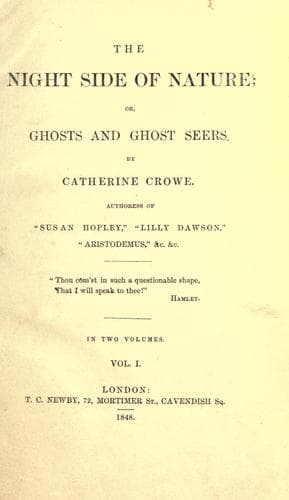
The Night-Side of Nature; Or, Ghosts and Ghost-SeersCrowe, Catherine
Religion
The Night-Side of Nature; Or, Ghosts and Ghost-Seers
Crowe, Catherine
Ghosts; Parapsychology
Gaffarillus, in his book, entitled “_Curiosités Inouies_,” published in
1650, when speaking on the subject of talismans, signatures, &c.,
observes that, since in many instances the plants used for these
purposes were reduced to ashes, and no longer retained their form, their
efficacy, which depended on their figure, should inevitably be
destroyed; but this, he says, is not the case, since, by an admirable
potency existing in nature, the form, though invisible, is still
retained in the ashes. This, he observes, may appear strange to those
who have never attended to the subject; but he asserts that an account
of the experiment will be found in the works of Mr. Du Chesne, one of
the best chemists of the period, who had been shown, by a Polish
physician at Cracow, certain vials containing ashes, which, when duly
heated, exhibited the forms of various plants. A small obscure cloud was
first observed, which gradually took on a defined form, and presented to
the eye a rose, or whatever plant or flower the ashes consisted of. Mr.
Du Chesne, however, had never been able to repeat the experiment, though
he had made several unsuccessful attempts to do so; but at length he
succeeded, by accident, in the following manner: Having for some purpose
extracted the salts from some burnt nettles, and having left the ley
outside the house all night, to cool, in the morning he found it frozen;
and, to his surprise, the form and figure of the nettles were so exactly
represented on the ice, that the living plant could not be more perfect.
Delighted at this discovery, he summoned Mr. De Luynes, parliamentary
councillor, to behold this curiosity; whence, he says, they both
concluded that, when a body dies, its form or figure still resides in
its ashes.
Kircher, Vallemont, Digby, and others, are said to have practised this
art of resuscitating the forms of plants from their ashes and at the
meeting of naturalists at Stuttgard, in 1834, a Swiss savant seems to
have revived the subject, and given a receipt for the experiment,
extracted from a work by Oetinger, called “Thoughts on the Birth and
Generation of Things.”—“The earthly husk,” says Oetinger, “remains in
the retort, while the volatile essence ascends, like a spirit, perfect
in form, but void of substance.”
Public-domain text, read in full here on John Shaqi.
Reviews
Reviews
No reviews yet
Be the first to share your thoughts on this work.
Elsewhere in the archive
Join the Discussion
Join the discussion
Sign in to leave a comment or review.
Sign InorCreate an account