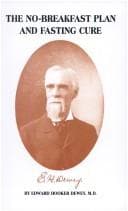
The No Breakfast Plan and the Fasting-CureDewey, Edward Hooker
Science
The No Breakfast Plan and the Fasting-Cure
Dewey, Edward Hooker
Fasting; Nutrition
"In this way, it is asserted, the alcohol habit is cured and
other diseases eradicated.
"Dr. F. B. Carpenter said yesterday to a reporter for _The
Press_ that he had not recommended Mr. Rathbun to take the fast,
but had advised him while it was going on and after it was over.
The doctor said he was inclined to believe there might be
something in the no-breakfast system, as a great many persons
eat and drink altogether too much.
"Dr. Helmer said he had examined Rathbun on the twenty-fifth
day, and had found him in surprisingly good condition."
Mr. Rathbun had been on the no-breakfast plan for several years, and he
was one of the first to write me after my book came out. It was not
without reason he feared apoplexy, for Ex-Gov. Flower, an over-weighted
man, had gone down to instant death though seemingly in perfect health
and in the prime of business energy and mental capacity. During his fast
my only trouble with him was in his drinking so much water without
thirst, thus greatly and needlessly adding to the work of the kidneys.
Mr. Rathbun was so disappointed over the skepticism of New York
physicians as to the reliability of the fast that he determined to
undergo a longer one under such surveillance as would enforce
conviction. He was mainly actuated, however, to go through the ordeal in
the interests of science.
Again I had trouble with him on the water question, wishing him to drink
only as thirst incited. He was differently advised by an eminent Boston
physician, who, taking a great interest in the case, wrote him that he
should have great care to drink certain definite amounts for the
necessary fluidity of the blood. I had to respond that thirst would duly
indicate this need; that in my cases of protracted fasts from acute
sicknesses not one had been advised to take even a teaspoonful of water
for such reasons; that at the closing days before recovery of such cases
there was only the least desire for water, and this with no indication
of need from the blood. Mr. Rathbun did not escape some trouble from
overworked kidneys, and he became convinced that my theory and practice
were more in line with physiology.
This fast was made a matter of daily record by the leading New York
journals, and he became such a subject of general interest that in
addition to his ordinary business he was greatly overtaxed, and was
compelled to give up the fast on the thirty-fifth day, in part from the
exhaustion of over-excitement.
This case was summed up as follows by the _New York Press_, February 27,
1900:
"Milton Rathbun has ended his long fast.
"After thirty-five days, in which solid food or any liquid other
than water was a stranger to his palate, he became extremely
hungry on Sunday night. At first he resisted the longing to eat
and tried to sleep it off. But he awoke in a few hours hungrier
than ever, and then he decided he had fasted as long as was good
for him.
Public-domain text, read in full here on John Shaqi.
Reviews
Reviews
No reviews yet
Be the first to share your thoughts on this work.
Elsewhere in the archive
Join the Discussion
Join the discussion
Sign in to leave a comment or review.
Sign InorCreate an account