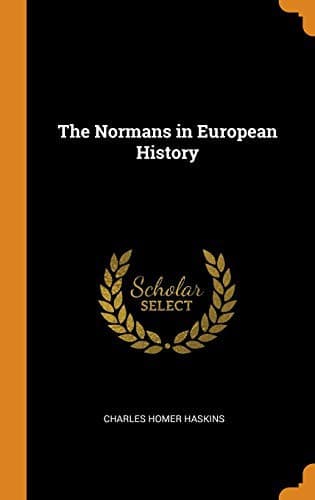
The Normans in European historyHaskins, Charles Homer
History
The Normans in European history
Haskins, Charles Homer
Europe -- History; Great Britain -- History -- Medieval period, 1066-1485; Normans -- Europe
of plan, of his thirteen books reflects the changes of design and the
interruptions which the work underwent; there is some repetition, much
confusion, and a distinct absence of architectonic art. These defects,
however, do not diminish the prime merit of the work, which lies in its
replacement of the jejune annals of the older type by a full and ample
historical narrative, rich in detail, vivid in presentation, giving
space to literary history and everyday life as well as to the affairs
of church and state, and constituting as a whole the most faithful
and living picture which has reached us of the European society of
his age. Neither in the world nor of the world, this monk had a ripe
knowledge of men and affairs, independence of judgment, a feeling for
personality, and a sure touch in characterization. He had also a Latin
style of his own, labored at times rather than affected, ready to show
its skill in well-turned verse or in well-rounded speeches after the
fashion of the classical historians, but direct and vigorous and not
unworthy of the flexible and sonorous language which he had made his
own.
Latin, however, was an exclusive possession of the clergy,--and not
of all of them, if we can argue from the examinations held by Eudes
Rigaud,--and by the middle of the twelfth century the Norman baronage
began to demand from the clerks an account of the Anglo-Norman past in
a language which they too could understand. History in the vernacular
develops in France earlier than elsewhere, and in France earliest in
Normandy and in the English lands which shared the Norman speech and
produced the oldest surviving example of such a work, the _Histoire
des Engles_ of Gaimar, written between 1147 and 1151. The chief centre
for the production of vernacular history was the court of that patron
of ecclesiastical and secular learning, Henry II, and his Aquitanian
queen, to one or both of whom are dedicated the histories of Wace
and Benoît de Sainte-More. Wace, the most interesting of this group
of writers, was a native of Jersey and a clerk of Caen who turned an
honest penny by his compositions and won a canonry at Bayeux by the
most important of them, his _Roman de Rou_. Beginning with Rollo, from
whom it takes its name, this follows the course of Norman history to
the victory of Henry I in 1106, in simple and agreeable French verse
based upon the Latin chroniclers but incorporating something from
popular tradition. Such a compilation adds little to our knowledge, but
by the time of the Third Crusade we find a contemporary narrative in
French verse prepared by a _jongleur_ of Évreux who accompanied Richard
on the expedition. If we ignore the line, at best very faint, which in
works of this sort separates history from romance and from works of
edification, we must carry the Norman pioneers still further back, to
the _Vie de Saint Alexis_ which we owe probably to a canon of Rouen
in the eleventh century, and to the great national epic of mediæval
Public-domain text, read in full here on John Shaqi.
Reviews
Reviews
No reviews yet
Be the first to share your thoughts on this work.
Elsewhere in the archive
Join the Discussion
Join the discussion
Sign in to leave a comment or review.
Sign InorCreate an account