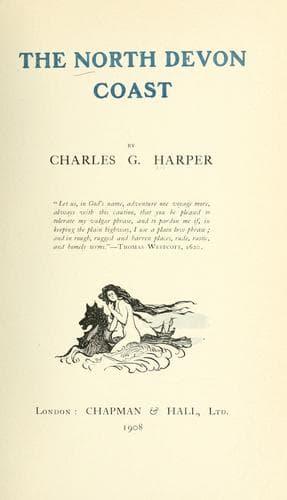
The North Devon CoastHarper, Charles G. (Charles George)
History
The North Devon Coast
Harper, Charles G. (Charles George)
Devon (England) -- Description and travel
The existing lighthouse looks like the design of some one who set
out to build an ordinary, four-square dwelling, and then conceived
the idea of placing a tower on its roof; and this tower, tapering
towards the lantern and carefully hung with slates, is strongly
shored up with metal-sheathed timbers, lest the stormy winds that
blow pretty constantly in winter overturn it. The lighthouse-man, who
spends his summer days gasping for air on the shady side, holds the
infrequent stranger in converse as long as possible, and does not
appear altogether contented with his existence on a spot where, he
says, you cannot bear to sit down on the sands in summer, for the heat,
which is strong enough to almost scorch your breeks, to say nothing of
your person, and in winter dare hardly put your nose out o’ doors, on
account of the cold. He will illustrate for you the especial dangers of
this point, against which the lighthouse is placed here to guard, and
will explain that, on account of the shifting, sandy bar of the river,
there are two lights provided: the fixed one on his tower, and another,
low down, on a movable white- and black-striped box on rails. This is
moved backwards and forwards, according to the movement of the bar, so
that ships entering the river and keeping their course safely, shall
get the two lights aligned.
The way between Braunton and the approach to Barnstaple, at Pilton,
is uninteresting. The road runs for the most part out of sight of the
river and the sea. Only one thing attracts the wayfarer’s attention;
and that for its singularity, rather than for any intrinsic beauty.
This object, beside the road, and so close to it that the wayfarer
cannot fail to notice the queer, would-be Gothic battlements, is
Heanton Court, now a farmhouse; the “Narnton Court” of Blackmore’s
“Maid of Sker.”
CHAPTER XI
PILTON--BARNSTAPLE BRIDGE--OLD COUNTRY WAYS--BARUM--HISTORY AND
COMMERCIAL IMPORTANCE--OLD HOUSES--“SEVEN BRETHREN BANK”--FREMINGTON--
INSTOW AND THE LOVELY TORRIDGE
Barnstaple is heralded by its suburb, Pilton, on a creek (or “pill”
as the word is here) of the river Yeo. The people of Pilton, who were
among the earliest to manufacture cotton fabrics in a district that
made only woollens, were in the early part of the seventeenth century
looked upon in much the same way as the makers of base coin are
regarded. “Woe unto ye, Piltonians,” exclaimed Westcote (1620), “who
make cloth without wool!”
Public-domain text, read in full here on John Shaqi.
Reviews
Reviews
No reviews yet
Be the first to share your thoughts on this work.
Elsewhere in the archive
Join the Discussion
Join the discussion
Sign in to leave a comment or review.
Sign InorCreate an account