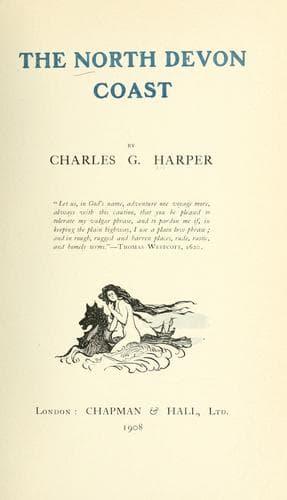
The North Devon CoastHarper, Charles G. (Charles George)
History
The North Devon Coast
Harper, Charles G. (Charles George)
Devon (England) -- Description and travel
“My grandfather died, I can’t tell ye how,
An’ lef’ me six oxen and likewise a plough;
I zold aff my oxen, and bought myzelf a cow.
Thinks I to myzelf, I shall have a dairy now.
I zold aff my cow, and bought myzelf a caaf.
Thinks I to myzelf, I have lost myzelf haaf.
I zold aff my caaf, an’ bought myzelf a cat,
An’ down in the carner the lill’ thing did squat.
I zold aff my cat, an’ bought myzelf a rat;
With vire tu his taal, he barnt my old hat.
I zold aff my rat, an’ bought myzelf a mouse,
An’ with vire tu his taal, he barnt down my house.”
Chorus:
“Whim-wham-jam-stram stram along, boys, down along the room.”
Barnstaple is in local speech, “Barum,” after that fashion which makes
Salisbury and Shrewsbury figure on the milestones round about as
“Sarum” and “Salop.” The name thus locally current has given a chance
to those modern rhymesters whose activity bids fair to presently fit
every place in the gazetteer with its more or less appropriate verse:
“There was a young lady of Barum,
Who said ‘Oh! bother skirts, I don’t wear ’em.
In knickers it’s easier
To walk in the breeze here
And, in climbing the cliffs, you don’t tear ’em’.”
It matters little, or nothing, that there are not any cliffs at
Barnstaple, and that you would not seek at this precise spot for the
most boisterous breezes.
The town is alike the oldest and the most important on this coast.
Long before that usual starting point, the coming of the Normans, it
figured prominently as Beardanstapol. Although it was once the site
of a castle, and was for many centuries a walled town with defensible
gates, its inhabitants were essentially, from the beginning, a trading
community, as the “staple” in the place name indicates. It was also
one of the oldest Parliamentary boroughs, having sent representatives
from 1295 until 1885, when ruthless redistribution, utterly without
sentiment, merged it in a county division. Then the ancient local
passion for bribery and corruption ceased automatically to be satisfied
at intervals by competitive candidates for the honour of representing
the “free and independent” burgesses, who greatly liked the free-handed
and rejected with scant ceremony those who were not prepared to dive
deeply into their pockets. Thus, when in 1865 Mr. Henry Hawkins,
afterwards Lord Brampton, was invited to stand in the Liberal interest,
the invitation was issued quite as much in the local interest and in
the expectation that he would be as liberal with his money as in his
political opinions. But the eagerly expectant people of Barnstaple
received a nasty shock, for the rising barrister refused to spend a
penny in bribery. The indignant electors, mindful of the glorious
election of 1841, when £80 was paid for one vote, had their feelings
outraged in the tenderest place, and rejected him with remarkable
completeness.
Public-domain text, read in full here on John Shaqi.
Reviews
Reviews
No reviews yet
Be the first to share your thoughts on this work.
Elsewhere in the archive
Join the Discussion
Join the discussion
Sign in to leave a comment or review.
Sign InorCreate an account