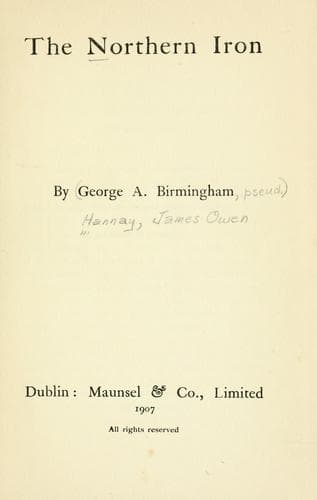
Historical fiction; Ireland -- History -- Rebellion of 1798 -- Fiction
He counted again, and only reached a total of eighteen slabs of stone.
He glanced down the passage, and found that he could not see the end of
it. He looked at the lamp. It was burning very low. It occurred to him
as an unpleasant possibility that the girl had taken away the wrong
lamp--had taken the one with the oil in it and left him the empty one.
He reassured himself. This lamp was a different shape from that which
hung in the passage when he first took his post as sentry. He made up
his mind that its wick must require to be turned up. Perhaps it had been
badly trimmed. The girl who brought it was evidently sleepy; she would
be very likely to forget to trim it. He stepped forward to where the
lamp hung. He paused, startled by a slight noise at the far end of the
passage. He listened, but heard nothing more. It was necessary to lift
the lamp off the hook before he could trim the wick. He laid his musket
on the ground and reached up to it. As he did so he heard swift steps,
steps of heavy feet, on the flagged passage. They were quite close to
him. He looked round and caught a glimpse of Maurice St. Clair in the
act of springing on him. He was grappled by strong arms and flung to the
ground before he could do anything to defend himself. Maurice, kneeling
on him, put the point of a knife to his throat.
“If you speak one word or utter the slightest sound I cut your throat at
once.”
The unfortunate soldier lay still. Maurice, the knife still pricking the
man’s throat, crept slowly off him and knelt on the floor. With his left
hand he unclasped the soldier’s belt.
“Now,” he said, “turn over on your face, and put your hands behind you.”
The man obeyed, and felt the sharp point of the knife slip slowly round
his neck until it rested behind his ear.
“‘Remember,” said Maurice, “one good cut downwards now and you are a
dead man. Put your hands together.”
He pulled the leather belt clear with his left hand, then, dropping the
knife, he knelt on the man’s back and gripped his wrists.
In a moment he had them securely strapped together with the leather
belt. Then he stuffed a cloth into the soldier’s mouth and bound it
there with a stout cord tied tight round his head. Another cord--Maurice
had come well supplied with what he was likely to want--was made fast
round the man’s legs. Then Maurice stood up and surveyed his handiwork.
He laughed softly, well satisfied. The lamp flickered and went out.
“It’s a good job for you,” said Maurice, “that the light lasted as long
as it did. I couldn’t have gagged and tied you in the dark. I should
have been obliged to kill you.”
He felt along the wall until he came to the cellar door and found the
keyhole. After much fumbling he got the key in, turned it, and pushed
open the door.
“Neal,” he called. “Neal, are you there?”
“Yes. Who is that? Is it you, Maurice? It’s like your voice.”
Public-domain text, read in full here on John Shaqi.
Reviews
Reviews
No reviews yet
Be the first to share your thoughts on this work.
Elsewhere in the archive
Join the Discussion
Join the discussion
Sign in to leave a comment or review.
Sign InorCreate an account