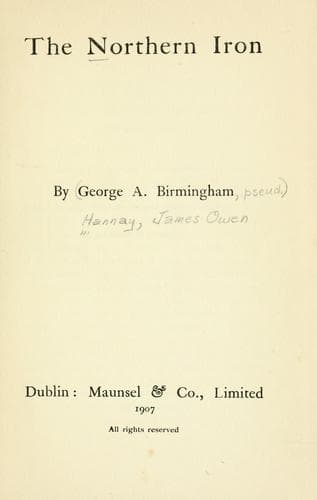
Historical fiction; Ireland -- History -- Rebellion of 1798 -- Fiction
Early next morning Neal bade farewell to Hope and started on his walk
to Donegore. For a while he kept along the side of the hill above the
homesteads that clustered on the lower slopes. Nearing Carnmoney he
descended and entered a small inn in order to obtain some breakfast. He
found the master and his wife in a state of great excitement at the news
which had just reached them that their son had been arrested in Belfast.
It was some time before Neal could persuade the poor people to attend to
his wants, and it was a wretched breakfast which he obtained in the end.
Leaving the inn, he walked along the high road through Molusk. He felt
tolerably safe, though bodies of troops and yeomen occasionally passed
him. His appearance was known to very few, and the people of the
district through which he was going were either United Irishmen or in
strong sympathy with the society. It was unlikely that any small body of
troops would venture to make an arrest unless the officer in command
was perfectly certain of the identity of his prisoner. So bold and
determined were the people that Neal, stopping opposite a forge, saw the
smith fashioning pike heads openly, and apparently fearlessly. A number
of men stood round the forge door talking earnestly together. Among them
was Phelim, the blind piper, whom Neal had seen in the street of Antrim.
They did not care to be silent or to lower their tones when Neal came
within earshot.
“The place of the muster,” said the piper, “is the Roughfort. Mind you
that now, and let them that has guns or pikes bring them.”
“And will M’Cracken be there?”
“Ay, he will. Did you no see the proclamation?”
“Will Kelso,” said some one to the smith, “are you working hard, man?
We’ll be needing a hundred more of them pike heads by the morrow’s
morn.”
The smith let his hammer fall with a clang on the anvil, and wiped his
brow.
“If you do as good a day’s work the morrow with what I’m working on the
day there’ll be no cause to complain of you.”
For the first time since he left Dunseveric Neal felt a glow of hope for
the success of the movement. He knew what kind of men these farmers
and weavers of Carnmoney and Templepatrick were--austere, cold men,
difficult to stir to violent action; much more difficult to cow into
submission when once roused. And it appeared to him that they were
effectually roused now. He recalled his father’s fanciful application of
the verse from the prophet Jeremiah. He felt, as he listened to the men
round the forge, the hardness of “the northern iron and the steel.” Was
there among the blustering yeomen and the disciplined troops of the King
iron strong enough to break this iron?
Public-domain text, read in full here on John Shaqi.
Reviews
Reviews
No reviews yet
Be the first to share your thoughts on this work.
Elsewhere in the archive
Join the Discussion
Join the discussion
Sign in to leave a comment or review.
Sign InorCreate an account