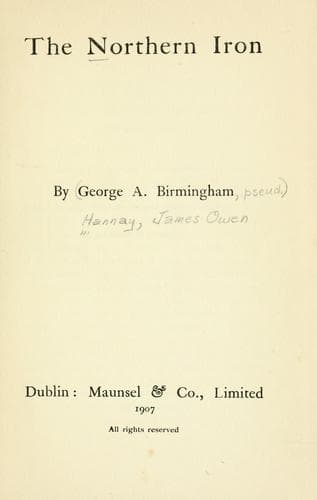
Historical fiction; Ireland -- History -- Rebellion of 1798 -- Fiction
“We do not mean to murder you. We mean to try you fairly, to acquit or
condemn you in strict justice. The first charge against you is
this. Having been sworn a member of the United Irishmen’s society in
Dunseveric, having been elected a member of the committee, you did in
Belfast betray the fact that there were cannons hidden in Dunseveric
meeting-house, and gave the names of your fellow-members to the military
authorities.”
“I deny it,” said James Finlay. “You have no proof of what you assert.
Will you murder a man on suspicion?”
“Neal Ward,” said Donald, “is this the James Finlay who was sworn into
the society by your father?”
“Yes,” said Neal.
“Tell us what you know about the visit of the yeomen to Dunseveric.”
Neal repeated the story, telling how he knew that his own name was on
the list of persons to be arrested. There was a short silence when he
had finished. Then James Bigger said--
“You have not proved that charge. The circumstances are suspicious, but
you have proved nothing.”
Donald Ward bowed. Finlay raised his eyes for the first time since he
had been dragged into the vault, and looked round him. There had risen
in him a faint gleam of hope.
“You are charged,” said Donald again, “with having provided the dragoons
who rioted in Belfast last week with information which led them to
attack and wreck the houses of those who are in sympathy with the
society.”
“I deny it. I was not in Belfast that day. I was here in Donegore with
Aeneas Moylin.”
“You were here the day before,” said Moylin. “You left me that day
early. You might have been in Belfast.”
“I was not,” said Finlay.
Donald Ward produced the scrap of paper which Peg Macllrea had taken
from the dragoon.
“Is that your handwriting?” he asked.
James Finlay looked at it.
“No,” he said.
“James Bigger, give me the last letter you had from Finlay. Now put the
lantern down on the floor.”
He looked steadily at the two papers, and then said--
“In my opinion these two are written in the same hand.”
He passed them to the man next him. They went from one to another, and
the lantern followed them on their round. Each man examined them, and
each nodded assent to Donald’s judgment.
“Let me see them,” said Finlay.
They were handed to him.
“I wrote neither of them,” he said.
“Your name is signed to one,” said Donald.
“I did not write it. I had hurt my hand on the day that note was
written. I employed another man to write for me. The writing is his, not
mine.”
“Name the man you employed.”
“Kelso, James Kelso.”
“Kelso was flogged yesterday,” said Donald, “and is in prison now. Do
you expect us to believe that he is an informer? Is flogging the wages
the Government pays to spies?”
“I tried to save Hope yesterday,” said Finlay. “Neal Ward, you have
borne witness against me, tell the truth in my favour now.”
“I believe,” said Neal, “that he did his best to save Hope and me
yesterday. I believe that he wanted to save us.”
Public-domain text, read in full here on John Shaqi.
Reviews
Reviews
No reviews yet
Be the first to share your thoughts on this work.
Elsewhere in the archive
Join the Discussion
Join the discussion
Sign in to leave a comment or review.
Sign InorCreate an account