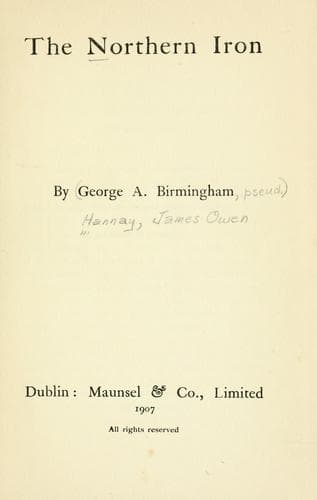
Historical fiction; Ireland -- History -- Rebellion of 1798 -- Fiction
The sergeant saluted, and marched Neal out of the house. His coat was
dragged off him, his shirt stripped from his back, his hands tied to the
tree which stood before Moylin’s house. He set his teeth and waited.
The predominating feeling in his mind at first was not fear but furious
anger. He had shrunk in terror from the near prospect of seeing Finlay
die. He felt nothing now except a passionate desire for revenge.
The sergeant swung the trooper’s belt round his head, making it whistle
through the air. Neal shivered and shrank, but the blow did not fall.
The sergeant was in no hurry.
“You hear that,” he said, swinging the belt again. “Will you speak
before I lay it on you? You shall have time to consider. Nobody shall
say I hurried a prisoner. We’ll sing you a psalm, my dearly beloved, a
sweet psalm to a most comfortable tune. At the end of the first verse
I’ll give you another chance. If you don’t speak then----. Now Tarn,
now lads all, tune up to the Ould Hunderd,
“‘There was a Presbyterian cat
Who loved her neighbour’s cream to sup;
She sanctified her theft with prayer
Before she went to drink it up.’”
The troopers, who appeared to have learned both tune and words since the
night when the sergeant sang them in Dunseveric meeting-house, shouted
lustily. Following their sergeant, they drawled the last line until it
seemed to Neal as if they would never reach the end of it.
“Now, Mr. Neal Ward,” said the sergeant, “you’ve had a most comfortable
and cheering psalm for the hour of your affliction. Will you speak,
or----. Damn your soul, Tam, what are you at?”
The man next him lurched suddenly forward, clutching at the sergeant.
In another instant there was a dull thud, and Donald Ward stood over
the sergeant with a pistol, grasped by its barrel, in his hand. He had
brought the butt of it down on the man’s skull. Two more of the yeomen
fell almost at the same instant. The rest, three of them with wounds,
fled, yelling, down the lane.
“The croppies are on us! Hell and murder! We’re dead men!”
There were about twenty of them, all well armed, but a night surprise
has a tendency to shake the firmest nerves. Captain Twinely and his
fellow-officer played no very heroic part. At the first sound of the
shouting and the footsteps of the flying troopers they rushed into the
inner room and crawled under the bed, fighting desperately with each
other for the place nearest the wall, but Donald Ward had no time to go
after them.
“Cut the boy down,” he said.
It was Felix Matier who set Neal free.
“Oh, whistle and I will come to you, my lad,” he quoted, as he hustled
the shirt over Neal’s shoulders. “Why didn’t you whistle, Neal, or
shout, or something? Only for that devil’s song we’d never have found
you. I guessed he was at some mischief when I heard him begin it.”
Public-domain text, read in full here on John Shaqi.
Reviews
Reviews
No reviews yet
Be the first to share your thoughts on this work.
Elsewhere in the archive
Join the Discussion
Join the discussion
Sign in to leave a comment or review.
Sign InorCreate an account