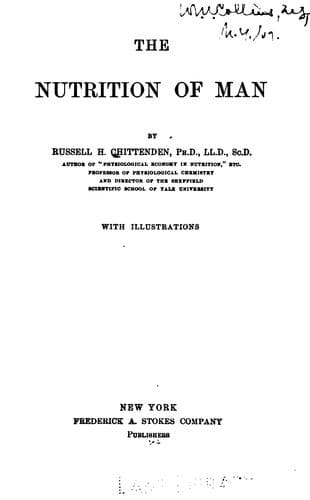
The nutrition of manChittenden, R. H. (Russell Henry)
Science
The nutrition of man
Chittenden, R. H. (Russell Henry)
Nutrition
There is no question that the energy of muscular contraction can come
from all three classes of organic foodstuffs. Voluntary muscular
movement is under the control of the nervous system, and when the
stimulus is applied the muscle is bound to contract, provided of
course there is sufficient energy-containing material present to
furnish the means. Muscle tissue, like other tissues and organs, has
a certain power of adaptability, by which it is able to do its work,
even though it is not adequately supplied with its preferred nutrient.
While proteid is plainly not the material from which the energy of
muscular contraction is ordinarily derived, it is equally evident
that in emergency, as when the usual store of carbohydrate and fat is
wanting, proteid can be drawn upon, and in such cases vigorous work
may be attended with increased nitrogen output. In harmony with this
statement, we find on record in recent years many experiments, both
with man and animals, where severe muscular labor is accompanied by an
excretion of nitrogen beyond what occurs on days of rest; but by simply
adding to the intake of non-nitrogenous food this increased outgo of
nitrogen is at once checked. With moderate work, the nitrogen outgo
is rarely influenced; it is only when the work becomes excessive, or
the store of non-nitrogenous reserve is small and the intake of the
latter food is limited, that proteid matter is drawn upon to supply the
required energy.
Recalling what has been said regarding the significance of the
respiratory quotient, it is obvious that we have here a means of
acquiring information as to the character of the material that is
burned up in the body during muscular work. Increased metabolism
of carbohydrate will necessarily result in raising the respiratory
quotient, and if the latter food material alone is involved the
respiratory quotient must naturally approach 1.0. Zuntz, however, has
clearly shown that vigorous muscular activity does not materially
change the respiratory quotient; except in cases of very severe work,
where the oxygen-supply of the muscles is interfered with. Indeed, the
muscles may be made to do work sufficient to increase the consumption
of oxygen threefold or more, without any change in the respiratory
quotient being observed. And as there is frequently no change whatever
in the output of nitrogen under these conditions, it follows that the
energy of the muscle work must have come from the decomposition of
non-nitrogenous material. If carbohydrates alone were involved, the
respiratory quotient would obviously undergo change. Since, however,
this remains practically stationary, we are led to the conclusion that
fat must be involved in large degree, in addition to carbohydrate.
Public-domain text, read in full here on John Shaqi.
Reviews
Reviews
No reviews yet
Be the first to share your thoughts on this work.
Elsewhere in the archive
Join the Discussion
Join the discussion
Sign in to leave a comment or review.
Sign InorCreate an account