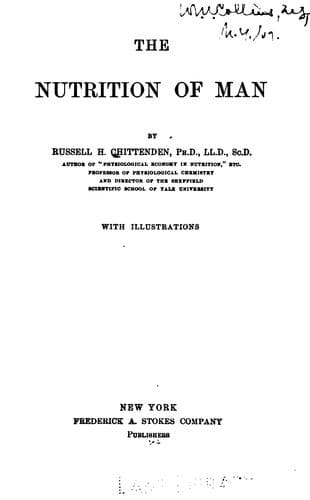
The nutrition of manChittenden, R. H. (Russell Henry)
Science
The nutrition of man
Chittenden, R. H. (Russell Henry)
Nutrition
Proteid foods are usually costly, and the ability of a community to
indulge freely in this form of dietetic luxury depends in large measure
upon its commercial prosperity. The palate is an extremely sensitive
organ, and the average individual properly derives great satisfaction
from the pleasurable effects of tasty articles of food. Furthermore,
there are many curious and quite unphysiological notions abroad
regarding foods, which tend to incite persons to unnecessary excess
and extravagance whenever they acquire the means to do so. The latter
point is well illustrated by the more or less prevalent opinion that a
cut of tenderloin steak is more nutritious than a cut of round steak.
It is true that the former is apt to be more tender, to have a little
finer flavor; but the round steak, when properly prepared, is just as
nutritious, and equally capable of meeting the needs of the body, as
the more expensive tenderloin. With increasing prosperity, we turn at
once, as a rule, to the more tasty and appetizing viands, partly to
satisfy the craving of appetite and palate, and partly because there
is an inherent belief that these varied delicacies, accessible to the
prosperous community, count as an aid to health and strength. The poor
laborer, with his small wage, is restricted to a certain low level
of dietary variety, and must likewise be economical as to quantity,
but on the first opportunity afforded by a fuller purse he is apt
to pass from corned beef to a fresh roast with its more appetizing
flavor; to eschew brown bread in favor of the white loaf, and in many
other ways to evince his desire for a dietary which, though perhaps no
more nutritious, appeals because of its finer flavor, more appetizing
appearance, and greater variety. He is in the same position as the
smoker who, limited by his purse to a five-cent cigar after dinner,
quickly passes to a cigar of better flavor as soon as his finances
warrant the indulgence. At the same time, if prosperity continues, our
laborer will speedily pass to a higher level of proteid intake and
greater fuel value, through increased consumption of meat and butter,
together with other articles rich in proteid and fat.
In this connection, we may emphasize a fact of some significance in its
bearing on dietetic customs; viz., that ever since Liebig advanced his
theory that proteid material is the sole source of muscular energy,
there has been a deep-rooted belief that meat is the most efficient
kind of food for keeping up the strength of the body, and hence
especially demanded by all whose work is mainly physical. Although this
view, as we have seen, has been thoroughly disproved, the idea is still
more or less generally held that an abundance of meat is a necessary
requisite for a good day’s work, a view which undoubtedly accounts in
some measure for the tendency toward a high proteid intake, evinced by
many of the laboring class whose means will permit the necessary outlay.
Public-domain text, read in full here on John Shaqi.
Reviews
Reviews
No reviews yet
Be the first to share your thoughts on this work.
Elsewhere in the archive
Join the Discussion
Join the discussion
Sign in to leave a comment or review.
Sign InorCreate an account