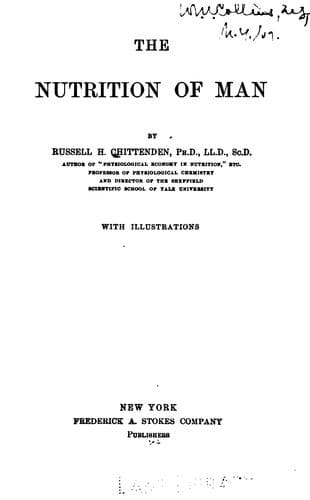
The nutrition of manChittenden, R. H. (Russell Henry)
Science
The nutrition of man
Chittenden, R. H. (Russell Henry)
Nutrition
One group of subjects was composed of professional men, professors and
instructors in the university, whose work was mainly mental rather
than physical, though by no means excluding the latter. Of this group,
two cases will be referred to with some regard for detail, since in
no other way can so striking a picture be presented of the effects
produced. The first subject weighed 65 kilos in the fall of 1902, and
at that time was nearly 47 years of age. His dietetic habits were in
accord with common practice, and his daily consumption of proteid food
averaged close to 118 grams. With a clear recognition of the principle
that the habits of a lifetime should not be too suddenly changed, a
very gradual reduction in the total amount of food, and especially of
proteid matter, was made. This finally resulted, with this particular
subject, in the complete abolition of breakfast, with the exception of
a small cup of coffee. A light lunch was taken at noontime, followed by
a more substantial dinner at night. There was no change to a vegetable
diet, but naturally any attempt to cut off largely the amount of
proteid food necessarily results in a marked diminution in the quantity
of animal food or meats. It is a somewhat singular though suggestive
fact, that a change of this order gradually results in a stronger
liking for simple foods, with their more delicate flavor, accompanied
by a diminished desire for the heavier animal foods.
As the day’s ration was gradually reduced in amount, the body-weight
began to fall off, until after some months it became stationary at 57
kilos, at which point it has remained practically constant for over
three years. The sixteen pounds of weight lost was composed, mainly at
least, of superfluous fat. For a period of nine months, from October,
1903, to the end of June, 1904, the amount of proteid material broken
down in the body was determined each day. The average daily metabolism
of nitrogen for the entire period of nearly nine months amounted to
5.69 grams. For the last two months, it averaged 5.4 grams per day.
Analyses made from time to time since these figures were obtained show
that the subject is still living at the same low level of nitrogen
metabolism. In fact, the data available afford satisfactory proof
that for a period covering over three years this particular person
has subsisted on an amount of proteid food equal to a metabolism of
not more than 5.8 grams of nitrogen per day. It may be asked why the
subject should have continued such a low proteid diet after the nine
months’ period was completed? In reply, it may be said that the new
habit has taken a firm hold, and entirely supplanted the dietetic
desires and cravings of the preceding years. Further, the improved
condition of health, freedom from minor ailments that formerly caused
inconvenience and discomfort, and the greater ability to work without
fatigue, have all combined to place the new habit on a firm basis, from
which there is no desire to change.
Public-domain text, read in full here on John Shaqi.
Reviews
Reviews
No reviews yet
Be the first to share your thoughts on this work.
Elsewhere in the archive
Join the Discussion
Join the discussion
Sign in to leave a comment or review.
Sign InorCreate an account