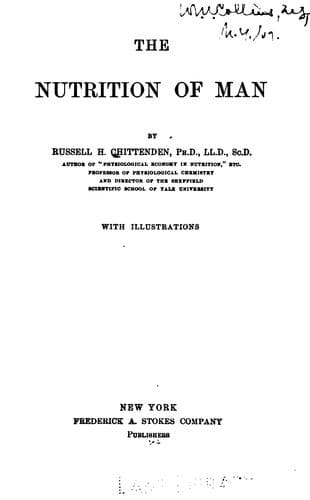
The nutrition of manChittenden, R. H. (Russell Henry)
Science
The nutrition of man
Chittenden, R. H. (Russell Henry)
Nutrition
The series of experiments as a whole, however, is to be considered
in the light of additional data bearing on the dietary customs of a
people who for generations have apparently lived and thrived on a daily
ration noticeably low in its content of proteid, as well as low in its
calorific value. As Oshima states, “It is probably fair to infer that
the amount of proteid in the dietaries of the classes living largely on
vegetable foods (and they constitute the larger part of the population)
may not be very far from 60 grams per day,” or 45 grams of digestible
proteid. It is reasonable to assume that the people live in this way
from force of habit or of necessity, and we may agree with Baelz, a
professor connected with the medical faculty of Tokyo University, “that
their diet is sufficient from a physiological standpoint.” Doubtless a
mixed diet, with a larger proportion of animal food, did their means
readily permit, would offer some advantages from the standpoint of
palatability and variety, but it is questionable if any material gain
in health or strength would result. “It is sometimes remarked,” says
Oshima, “that the peasants in the rural districts of Japan, living
largely on vegetable food, are really healthier and stronger than
people of the better classes, who live on a mixed diet, and the better
physical condition of the former is commonly believed to be due to
their diet.” This, however, is a difficult matter to decide, since
there are so many other factors that are liable to play a part, such as
the general conditions of life which are so widely different in the two
classes.
It is plainly evident that the daily diet of the great bulk of the
Japanese people has been characterized by a very low proteid standard,
as contrasted with the standards and usages of the majority of
European and American people. The fact is brought forward merely as
confirmatory evidence, on a large scale, of the perfect safety of
lowering the consumption of proteid food to somewhere near the level of
the physiological requirements of the body. Generations of low proteid
feeding, with the temperance and simplicity in dietary matters thereby
implied, have certainly not stood in the way of phenomenal development
and advancement when the gateway was opened for the ingress of modern
ideas from western civilization. Many changes are sure to follow in
the footsteps of the nation’s progress, and among these it is safe to
prophesy that as public and private wealth, and resources in general,
increase, the dietary of the people will gradually assume a more varied
character with corresponding increase in volume. Whether such a change
will prove of real benefit to the race, time alone can determine.
Public-domain text, read in full here on John Shaqi.
Reviews
Reviews
No reviews yet
Be the first to share your thoughts on this work.
Elsewhere in the archive
Join the Discussion
Join the discussion
Sign in to leave a comment or review.
Sign InorCreate an account