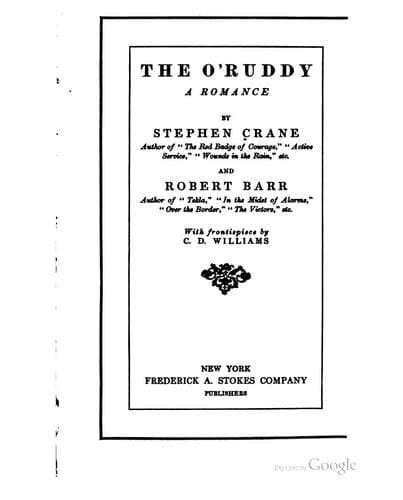
Adventure stories; England -- Social life and customs -- 18th century -- Fiction; Irish -- England -- Fiction
My excellent and adjacent friend turned to me in a burst of
enthusiasm.
"And did you ever hear a thing so well turned? Ha, ha! 'My good friend
Bobbs,' quoth he, 'I see your nose gradually is turning red.' Ha, ha,
ha! By my King, I have seldom heard a wittier answer."
"Bedad!" said I, somewhat bewildered, but resolved to appreciate the
noted master of wit, "it stamped the drama down into the ground. Sure,
never another play will be delivered in England after that tremendous
overthrow."
"Aye," he rejoined, still shuddering with mirth, "I fail to see how
the dramatists can survive it. It was like the wit of a new
Shakespeare. It subsided Bobbs to nothing. I would not be surprised at
all if Bobbs now entirely quit the writing of plays, since Fullbil's
words so closely hit his condition in the dramatic world. A dangerous
dog is this Fullbil."
"It reminds me of a story my father used to tell--" I began.
"Sir," cried my new friend hastily, "I beg of you! May I, indeed,
insist? Here we talk only of the very deepest matters."
"Very good, sir," I replied amiably. "I will appear better, no doubt,
as a listener; but if my father was alive--"
"Sir," beseeched my friend, "the great Fancher, the immortal critic,
is about to speak."
"Let him," said I, still amiable.
A portly gentleman of middle age now addressed Bobbs amid a general
and respectful silence.
"Sir," he remarked, "your words concerning the great age of what I
shall call the five-minutes-intelligent-explanation theory was first
developed by the Chinese, and is contemporaneous, I believe, with
their adoption of the custom of roasting their meat instead of eating
it raw."
"Sir, I am interested and instructed," rejoined Bobbs.
Here old Fullbil let go two or three growls of scornful disapproval.
"Fancher," said he, "my delight in your company is sometimes dimmed by
my appreciation of your facilities for being entirely wrong. The great
theory of which you speak so confidently, sir, was born no earlier
than seven o'clock on the morning of this day. I was in my bed, sir;
the maid had come in with my tea and toast. 'Stop,' said I, sternly.
She stopped. And in those few moments of undisturbed reflection, sir,
the thought came to life, the thought which you so falsely attribute
to the Chinese, a savage tribe whose sole distinction is its ability
to fly kites."
After the murmurs of glee had died away, Fancher answered with spirit:
"Sir, that you are subject to periods of reflection I will not deny, I
cannot deny. Nor can I say honourably that I give my support to our
dramatic friend's defence of his idea. But, sir, when you refer to the
Chinese in terms which I cannot but regard as insulting, I am
prepared, sir, to--"
There were loud cries of "Order! Order! Order!" The wrathful Fancher
was pulled down into his chair by soothful friends and neighbours, to
whom he gesticulated and cried out during the uproar.
Public-domain text, read in full here on John Shaqi.
Reviews
Reviews
No reviews yet
Be the first to share your thoughts on this work.
Elsewhere in the archive
Join the Discussion
Join the discussion
Sign in to leave a comment or review.
Sign InorCreate an account