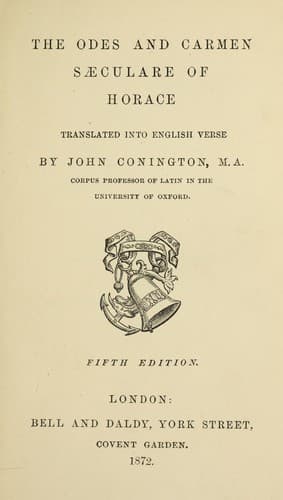
Horace -- Translations into English; Laudatory poetry, Latin -- Translations into English
In sacred awe the silent dead
Attend on each.
"'Sacro digna silentio:' digna eo silentio quod in sacris
faciendis observatur."--RITTER.
BOOK II, ODE 14.
Not though three hundred bullocks flame
Each year.
I have at last followed Ritter in taking trecenos as loosely put for
365, a steer for each day in the year. The hyperbole, as he says, would
otherwise be too extravagant. And richer spilth the pavement stain.
"Our vaults have wept
With drunken spilth of wine."
SHAKESPEARE, Timon of Athens.
BOOK II, ODE 18.
Suns are hurrying suns a-west,
And newborn moons make speed to meet their end.
The thought seems to be that the rapid course of time, hurrying men to
the grave, proves the wisdom of contentment and the folly of avarice.
My version formerly did not express this, and I have altered it
accordingly, while I have rendered "Novaeque pergunt interire lunae"
closely, as Horace may perhaps have intended to speak of the moons as
hastening to their graves as men do.
Yet no hall that wealth e'er plann'd
Waits you more surely than the wider room
Traced by Death's yet greedier hand.
Fine is the instrumental ablative constructed with destinata, which is
itself an ablative agreeing with aula understood. The rich man looks
into the future, and makes contracts which he may never live to see
executed (v. 17--"Tu secanda marmora Locas sub ipsum funus"); meantime
Death, more punctual than any contractor, more greedy than any
encroaching proprietor, has planned with his measuring line a mansion
of a different kind, which will infallibly be ready when the day
arrives.
BOOK II, ODE 20.
I, whom you call
Your friend, Maecenas.
With Ritter I have rendered according to the interpretation which
makes dilecte Maecenas' address to Horace; but it is a choice of evils.
BOOK III, ODE 1.
And lords of land
Affect the sea.
Terrae of course goes with fastidiosus, not with dominus. Mine is a
loose rendering, not a false interpretation.
BOOK III, ODE 2.
Her robes she keeps unsullied still.
The meaning is not that worth is not disgraced by defeat in contests
for worldly honours, but that the honours which belong to worth are
such as the worthy never fail to attain, such as bring no disgrace
along with them, and such as the popular breath can neither confer nor
resume.
True men and thieves
Neglected Justice oft confounds.
"The thieves have bound the true men."
SHAKESPEARE, Henry IV, Act ii. Scene 2;
where see Steevens' note.
BOOK III, ODE 3.
No more the adulterous guest can charm
The Spartan queen.
I have followed Ritter in constructing Lacaenae adulterae as a dative
with splendet; but I have done so as a poetical translator rather than
as a commentator.
BOOK III, ODE 4.
Or if a graver note than, love,
With Phoebus' cittern and his lyre.
Public-domain text, read in full here on John Shaqi.
Reviews
Reviews
No reviews yet
Be the first to share your thoughts on this work.
Elsewhere in the archive
Join the Discussion
Join the discussion
Sign in to leave a comment or review.
Sign InorCreate an account