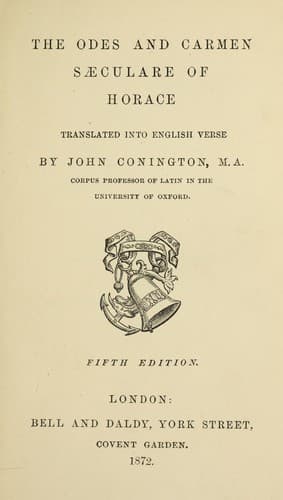
Horace -- Translations into English; Laudatory poetry, Latin -- Translations into English
On the whole, Ritter seems right, after Acron, in understanding curae
sagaces of the counsels of Augustus, whom Horace compliments similarly
in the Fourteenth Ode of this Book, as the real author of his step-
son's victories. He is certainly right in giving the stanza to Horace,
not to Hannibal. Even a courtly or patriotic Roman would have shrunk
from the bad taste of making the great historical enemy of Italy
conclude his lamentation over his own and his country's deep sorrow by
a flattering prophecy of the greatness of his antagonist's family.
BOOK IV, ODE 9.
'Twixt worth and baseness, lapp'd in death,
What difference?
I believe I have expressed Horace's meaning, though he has chosen to
express himself as if the two things compared were dead worthlessness
and uncelebrated worth. By fixing the epithet sepultae to inertiae he
doubtless meant to express that the natural and appropriate fate of
worthlessness was to be dead, buried, and forgotten. But the context
shows that he was thinking of the effect of death and its consequent
oblivion on worth and worthlessness alike, and contending that the poet
alone could remedy the undiscriminating and unjust award of destiny.
Throughout the first half of the Ode, however, Horace has rather failed
to mark the transitions of thought. He begins by assuring himself and,
by implication, those whom he celebrates, of immortality, on the ground
that the greatest poets are not the only poets; he then exchanges this
thought for another, doubtless suggested by it, that the heroes of
poetry are not the only heroes, though the very fact that there have
been uncelebrated heroes is used to show that celebration by a poet is
everything.
Or bear your banners through the fight,
Scattering the foeman's firm array.
It seems, on the whole, simpler to understand this of actual victories
obtained by Lollius as a commander, than of moral victories obtained by
him as a judge. There is harshness in passing abruptly from the
judgment-seat to the battle-field; but to speak of the judgment-seat as
itself the battle-field would, I think, be harsher still.
FINIS.
Public-domain text, read in full here on John Shaqi.
Reviews
Reviews
No reviews yet
Be the first to share your thoughts on this work.
Elsewhere in the archive
Join the Discussion
Join the discussion
Sign in to leave a comment or review.
Sign InorCreate an account