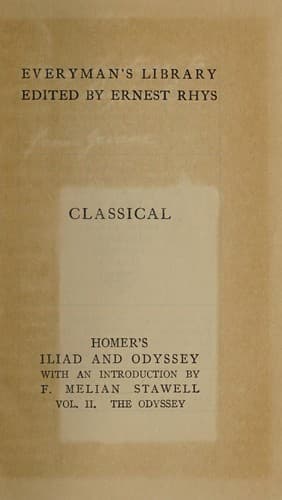
Epic poetry, Greek -- Translations into English; Homer -- Translations into English; Odysseus, King of Ithaca (Mythological character)
“‘Lo, we are Achaeans, driven wandering from Troy, by all manner of
winds over the great gulf of the sea; seeking our homes we fare, but
another path have we come, by other ways: even such, methinks, was the
will and the counsel of Zeus. And we avow us to be the men of
Agamemnon, son of Atreus, whose fame is even now the mightiest under
heaven, so great a city did he sack, and destroyed many people; but as
for us we have lighted here, and come to these thy knees, if perchance
thou wilt give us a stranger’s gift, or make any present, as is the due
of strangers. Nay, lord, have regard to the gods, for we are thy
suppliants; and Zeus is the avenger of suppliants and sojourners, Zeus,
the god of the stranger, who fareth in the company of reverend
strangers.’
“So I spake, and anon he answered out of his pitiless heart: ‘Thou art
witless, my stranger, or thou hast come from afar, who biddest me
either to fear or shun the gods. For the Cyclôpes pay no heed to Zeus,
lord of the aegis, nor to the blessed gods, for verily we are better
men than they. Nor would I, to shun the enmity of Zeus, spare either
thee or thy company, unless my spirit bade me. But tell me where thou
didst stay thy well-wrought ship on thy coming? Was it perchance at the
far end of the island, or hard by, that I may know?’
“So he spake tempting me, but he cheated me not, who knew full much,
and I answered him again with words of guile:
“‘As for my ship, Poseidon, the shaker of the earth, brake it to
pieces, for he cast it upon the rocks at the border of your country,
and brought it nigh the headland, and a wind bare it thither from the
sea. But I with these my men escaped from utter doom.’
“So I spake, and out of his pitiless heart he answered me not a word,
but sprang up, and laid his hands upon my fellows, and clutching two
together dashed them, as they had been whelps, to the earth, and the
brain flowed forth upon the ground, and the earth was wet. Then cut he
them up piecemeal, and made ready his supper. So he ate even as a
mountain-bred lion, and ceased not, devouring entrails and flesh and
bones with their marrow. And we wept and raised our hands to Zeus,
beholding the cruel deeds; and we were at our wits’ end. And after the
Cyclops had filled his huge maw with human flesh and the milk he drank
thereafter, he lay within the cave, stretched out among his sheep.
“So I took counsel in my great heart, whether I should draw near, and
pluck my sharp sword from my thigh, and stab him in the breast, where
the midriff holds the liver, feeling for the place with my hand. But my
second thought withheld me, for so should we too have perished even
there with utter doom. For we should not have prevailed to roll away
with our hands from the lofty door the heavy stone which he set there.
So for that time we made moan, awaiting the bright Dawn.
Public-domain text, read in full here on John Shaqi.
Reviews
Reviews
No reviews yet
Be the first to share your thoughts on this work.
Elsewhere in the archive
Join the Discussion
Join the discussion
Sign in to leave a comment or review.
Sign InorCreate an account