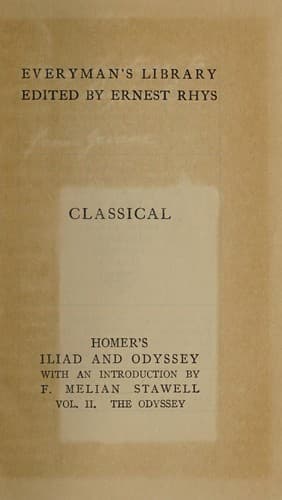
Epic poetry, Greek -- Translations into English; Homer -- Translations into English; Odysseus, King of Ithaca (Mythological character)
“Even so I spake, and anon my lady mother answered me: ‘Yea verily, she
abideth with steadfast spirit in thy halls; and wearily for her the
nights wane always and the days in shedding of tears. But the fair
honour that is thine no man hath yet taken; but Telemachus sits at
peace on his demesne, and feasts at equal banquets, whereof it is meet
that a judge partake, for all men bid him to their house. And thy
father abides there in the field, and goes not down to the town, nor
lies he on bedding or rugs or shining blankets, but all the winter he
sleeps, where sleep the thralls in the house, in the ashes by the fire,
and is clad in sorry raiment. But when the summer comes and the rich
harvest-tide, his beds of fallen leaves are strewn lowly all about the
knoll of his vineyard plot. There he lies sorrowing and nurses his
mighty grief, for long desire of thy return, and old age withal comes
heavy upon him. Yea and even so did I too perish and meet my doom. It
was not the archer goddess of the keen sight, who slew me in my halls
with the visitation of her gentle shafts, nor did any sickness come
upon me, such as chiefly with a sad wasting draws the spirit from the
limbs; nay, it was my sore longing for thee, and for thy counsels,
great Odysseus, and for thy loving-kindness, that reft me of sweet
life.’
“So spake she, and I mused in my heart and would fain have embraced the
spirit of my mother dead. Thrice I sprang towards her, and was minded
to embrace her; thrice she flitted from my hands as a shadow or even as
a dream, and sharp grief arose ever at my heart. And uttering my voice
I spake to her winged words:
“‘Mother mine, wherefore dost thou not abide me who am eager to clasp
thee, that even in Hades we twain may cast our arms each about the
other, and have our fill of chill lament? Is this but a phantom that
the high goddess Persephone hath sent me, to the end that I may groan
for more exceeding sorrow?’
“So spake I, and my lady mother answered me anon: ‘Ah me, my child, of
all men most ill-fated, Persephone, the daughter of Zeus, doth in no
wise deceive thee, but even on this wise it is with mortals when they
die. For the sinews no more bind together the flesh and the bones, but
the great force of burning fire abolishes these, so soon as the life
hath left the white bones, and the spirit like a dream flies forth and
hovers near. But haste with all thine heart toward the sunlight, and
mark all this, that even hereafter thou mayest tell it to thy wife.’
Public-domain text, read in full here on John Shaqi.
Reviews
Reviews
No reviews yet
Be the first to share your thoughts on this work.
Elsewhere in the archive
Join the Discussion
Join the discussion
Sign in to leave a comment or review.
Sign InorCreate an account