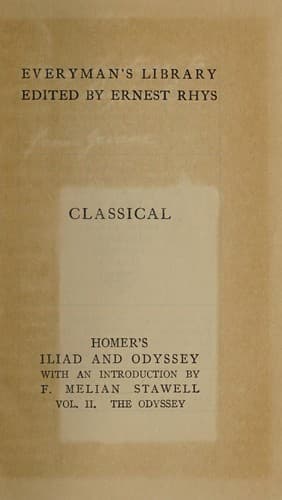
Epic poetry, Greek -- Translations into English; Homer -- Translations into English; Odysseus, King of Ithaca (Mythological character)
“Therewith he departed again into the house of Hades, but I abode there
still, if perchance some one of the hero folk besides might come, who
died in old time. Yea and I should have seen the men of old, whom I was
fain to look on, Theseus and Peirithous, renowned children of the gods.
But ere that might be the myriad tribes of the dead thronged up
together with wondrous clamour: and pale fear gat hold of me, lest the
high goddess Persephone should send me the head of the Gorgon, that
dread monster, from out of Hades.
“Straightway then I went to the ship, and bade my men mount the vessel,
and loose the hawsers. So speedily they went on board, and sat upon the
benches. And the wave of the flood bore the barque down the stream of
Oceanus, we rowing first, and afterwards the fair wind was our convoy.
BOOK XII.
Odysseus, his passage by the Sirens, and by Scylla and Charybdis. The
sacrilege committed by his men in the isle Thrinacia. The destruction
of his ships and men. How he swam on a plank nine days together, and
came to Ogygia, where he stayed seven years with Calypso.
“Now after the ship had left the stream of the river Oceanus, and was
come to the wave of the wide sea, and the isle Aeaean, where is the
dwelling place of early Dawn and her dancing grounds, and the land of
sunrising, upon our coming thither we beached the ship in the sand, and
ourselves too stept ashore on the sea beach. There we fell on sound
sleep and awaited the bright Dawn.
“So soon as early Dawn shone forth, the rosy-fingered, I sent forth my
fellows to the house of Circe to fetch the body of the dead Elpenor.
And speedily we cut billets of wood and sadly we buried him, where the
furthest headland runs out into the sea, shedding big tears. But when
the dead man was burned and the arms of the dead, we piled a barrow and
dragged up thereon a pillar, and on the topmost mound we set the shapen
oar.
“Now all that task we finished, and our coming from out of Hades was
not unknown to Circe, but she arrayed herself and speedily drew nigh,
and her handmaids with her bare flesh and bread in plenty and dark red
wine. And the fair goddess stood in the midst and spake in our ears,
saying:
“‘Men overbold, who have gone alive into the house of Hades, to know
death twice, while all men else die once for all. Nay come, eat ye meat
and drink wine here all day long; and with the breaking of the day ye
shall set sail, and myself I will show you the path and declare each
thing, that ye may not suffer pain or hurt through any grievous
ill-contrivance by sea or on the land.’
Public-domain text, read in full here on John Shaqi.
Reviews
Reviews
No reviews yet
Be the first to share your thoughts on this work.
Elsewhere in the archive
Join the Discussion
Join the discussion
Sign in to leave a comment or review.
Sign InorCreate an account