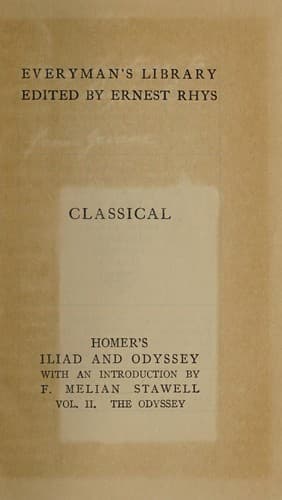
Epic poetry, Greek -- Translations into English; Homer -- Translations into English; Odysseus, King of Ithaca (Mythological character)
“Father Zeus, and all ye other blessed gods that live for ever,
henceforth let not any sceptred king be kind and gentle with all his
heart, nor minded to do righteously, but let him alway be a hard man
and work unrighteousness, for behold, there is none that remembereth
divine Odysseus of the people whose lord he was, and was gentle as a
father. Howbeit, as for him he lieth in an island suffering strong
pains, in the halls of the nymph Calypso, who holdeth him perforce; so
he may not reach his own country, for he hath no ships by him with
oars, and no companions to send him on his way over the broad back of
the sea. And now, again, they are set on slaying his beloved son on his
homeward way, for he is gone to fair Pylos and to goodly Lacedaemon, to
seek tidings of his father.”
And Zeus, gatherer of the clouds, answered and spake unto her: “My
child, what word hath escaped the door of thy lips? Nay, didst thou not
thyself plan this device, that Odysseus may assuredly take vengeance on
those men at his coming? As for Telemachus, do thou guide him by thine
art, as well as thou mayest, that so he may come to his own country all
unharmed, and the wooers may return in their ship with their labour all
in vain.”
Therewith he spake to Hermes, his dear son: “Hermes, forasmuch as even
in all else thou art our herald, tell unto the nymph of the braided
tresses my unerring counsel, even the return of the patient Odysseus,
how he is to come to his home, with no furtherance of gods or of mortal
men. Nay, he shall sail on a well-bound raft, in sore distress, and on
the twentieth day arrive at fertile Scheria, even at the land of the
Phaeacians, who are near of kin to the gods. And they shall give him
all worship heartily as to a god, and send him on his way in a ship to
his own dear country, with gifts of bronze and gold, and raiment in
plenty, much store, such as never would Odysseus have won for himself
out of Troy, yea, though he had returned unhurt with the share of the
spoil that fell to him. On such wise is he fated to see his friends,
and come to his high-roofed home and his own country.”
Public-domain text, read in full here on John Shaqi.
Reviews
Reviews
No reviews yet
Be the first to share your thoughts on this work.
Elsewhere in the archive
Join the Discussion
Join the discussion
Sign in to leave a comment or review.
Sign InorCreate an account